
Ark vs Playwriter

Ark
Ark is the white-label email API built for multi-tenant platforms like CRMs and helpdesks.
Last updated: February 28, 2026

Last updated: March 18, 2026
Visual Comparison
Ark
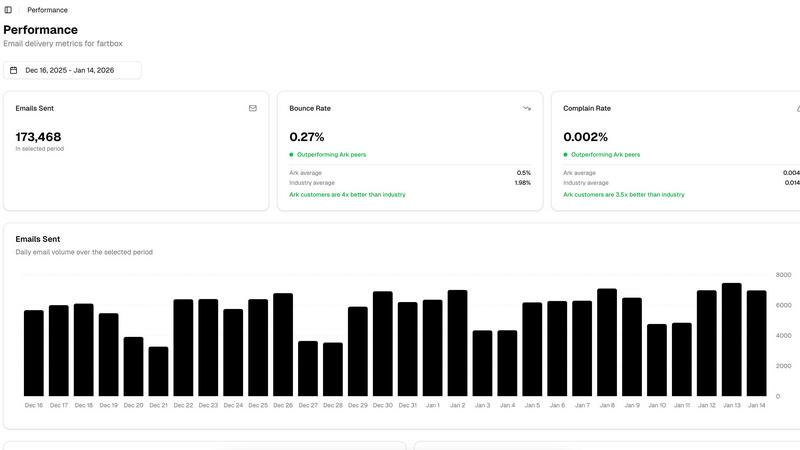
Playwriter

Feature Comparison
Ark
Native AI Agent Integration (MCP Server)
Ark comes with a built-in Model Context Protocol server featuring 26 dedicated tools, allowing AI coding assistants like Claude, Cursor, and Windsurf to send and manage emails directly through natural language prompts. This eliminates the need for boilerplate wrapper code and dramatically accelerates development workflows. The accompanying documentation is specifically optimized for AI readability, reducing token usage by up to 10x and making email functionality a natural extension of your AI-powered development process.
Built-In Multi-Tenant & White-Labeling
Every customer in your platform is fully isolated with their own domains, sending logs, and analytics dashboard. Ark is purpose-built for platforms, making it effortless to manage hundreds or thousands of customer domains from a single, unified interface. This white-label capability ensures your customers' emails come from their own branded domains (e.g., [email protected]), enhancing their professional image and making your platform an integral part of their business operations.
Automated Domain & DNS Management
Onboarding a new customer domain is a breeze. Ark automatically detects the customer's DNS provider (like Cloudflare, GoDaddy, or Route53) and provides them with exact, step-by-step instructions for configuration. For some providers, it can even auto-configure the necessary SPF, DKIM, and DMARC records. This self-service flow eliminates support tickets and Zoom calls explaining TXT records, getting new domains ready to send in minutes.
Real-Time Analytics & Webhooks
Gain complete visibility into your email ecosystem with real-time, per-customer analytics and webhooks. Track delivery rates, opens, clicks, and bounces for each tenant individually. This granular data allows you to instantly debug issues—like a single customer reporting missing emails—without sifting through a monolithic log file. Proactive monitoring and actionable insights are built directly into the dashboard.
Playwriter
Your Real Browser Session
Playwriter doesn't spawn a new, sterile browser. It attaches directly to your existing Chrome tabs via a debugger connection. This means every website you're already logged into—Gmail, GitHub, admin dashboards—is instantly available to your AI agent. Your extensions (like password managers or ad blockers) are active, and your cookies are present, completely bypassing the bot detection that plagues fresh, headless instances. It's browsing with your identity, without the overhead.
Full Playwright API Through a Single Tool
Instead of limiting agents to a fixed set of pre-defined tools (like "click" or "type"), Playwriter exposes one powerful execute tool. Your agent can run any valid Playwright code, unlocking the entire automation library: complex selectors, network interception, performance profiling, and setting breakpoints. This keeps the AI's context window lean by avoiding schema bloat from dozens of tool definitions and grants unparalleled flexibility.
Advanced Debugging & Collaboration Suite
Playwriter is built for real-world debugging and human-AI teamwork. It includes a live debugger with breakpoints, live code editing, and network request interception. You can watch the agent work in real-time on your screen. When it hits a CAPTCHA or a consent wall, you simply solve it and let the agent continue. If it gets stuck, you can temporarily disable control, fix the page manually, and re-enable it—seamless collaboration.
Lightweight Accessibility Snapshots & Recording
Forget massive, context-consuming screenshots. Playwriter generates compact accessibility snapshots (only 5-20KB) that provide the AI with a structured, semantic view of the page. It also includes visual labeling for elements and can record full video of the agent's session. Combined with network interception, this gives your AI deep, efficient insight into page state and behavior.
Use Cases
Ark
Multi-Tenant SaaS Platforms (CRMs, Helpdesks)
Platforms like CRMs and helpdesk software need to send notifications, alerts, and updates from each of their customer's own domains. Ark provides the isolated, white-label email infrastructure required for this, ensuring every client's communications are branded and authenticated properly without the platform developer having to build complex domain management systems from scratch.
Invoicing & Financial Applications
Invoicing tools require high-trust, domain-authenticated emails to ensure payment reminders and receipts reach the inbox and maintain professionalism. Ark enables these applications to send from customer domains like [email protected], directly increasing deliverability and trust for critical financial communications, all managed through a simple API.
AI-Powered Development & Automation Workflows
Development teams using AI agents (Claude Code, Cursor) or automation platforms (n8n, Vercel Serverless, Supabase Edge Functions) can integrate email sending as a native action. With Ark's MCP server and SDKs, sending an email becomes a natural language command or a simple function call within an existing workflow, supercharging productivity for AI-first developers.
Self-Hosted Tool Notification Systems
Tools like Listmonk (newsletters), Coolify (deployment), or Metabase (analytics) that are self-hosted often need a reliable SMTP relay for notifications. Ark's full SMTP relay support allows these tools to send high-deliverability emails without relying on consumer email services, providing enterprise-grade reliability and detailed logs for self-hosted environments.
Playwriter
Automated Web Testing & Debugging
Developers can instruct their AI assistant to run complex, multi-step user flows on their already-logged-in development or staging environments. The agent can click through UIs, fill forms, intercept API calls to verify payloads, and profile performance—all within the exact browser context a real user would have, making tests more reliable and context-aware.
AI-Powered Research & Data Extraction
Researchers and analysts can task an AI with gathering information from websites that require login or have complex interactive elements. Since Playwriter uses the real browser, it can navigate paywalls, logged-in databases, and JavaScript-heavy dashboards that are completely inaccessible to traditional, headless agent tools.
Routine Task Automation
Automate repetitive daily web tasks without writing a single line of code yourself. Have your AI agent log in to platforms, generate reports, schedule posts, or monitor status pages. Because it works in your browser session, it can handle two-factor authentication flows where you approve the login prompt.
Enhanced AI Assistant Capabilities
Supercharge coding assistants like Cursor or Claude. Instead of just writing hypothetical code, your AI can now execute Playwright scripts to interact with live documentation, pull examples from a web API, test a component in Storybook, or even debug a live web application by manipulating the DOM and inspecting network traffic in real-time.
Overview
About Ark
Ark is the revolutionary email API built from the ground up for AI-first developers and multi-tenant software platforms. Forget wrestling with single-sender email services that crumble under the weight of your customers' needs. Ark is the white-label email infrastructure that lets you embed professional, domain-authenticated email sending directly into your CRM, helpdesk, invoicing, or scheduling application. Its native MCP server with 26 tools allows AI agents like Claude, Cursor, and Windsurf to send emails through natural language, eliminating wrapper code and slashing token usage with AI-optimized documentation. Designed for platforms that send on behalf of their users, Ark provides built-in tenant isolation, per-customer domain management, and detailed analytics, so you can stop building email infrastructure and get back to your core product. With sub-second delivery, 99.9% deliverability, automatic email authentication, and a transparent pricing model, Ark empowers developers to ship faster, automate smarter, and scale seamlessly without the enterprise sales calls.
About Playwriter
Stop fighting with headless browsers and bot detection. Playwriter is the game-changing bridge that lets your AI agents operate directly within your real, logged-in Chrome browser. It's a Chrome extension and CLI that gives any MCP client (like Cursor, Claude Desktop, or VS Code) the full power of the Playwright automation API, but executed in your existing browser session. This means your agents have immediate access to all your extensions, cookies, and logins—no fresh Chrome instance, no extra memory load, and no instant red flags from websites. It turns the brittle, limited browsing of today's AI into a seamless, powerful, and collaborative experience. Built for developers, researchers, and power users who need their AI assistants to interact with the modern web as a human would, Playwriter is open-source (MIT licensed) and runs entirely locally on your machine, putting you in full control.
Frequently Asked Questions
Ark FAQ
How is Ark different from Resend or SendGrid?
Ark is fundamentally built for multi-tenant platforms, while services like Resend, SendGrid, and Postmark are designed for a single company to send from its own domains. Ark provides built-in tenant isolation, per-customer domain management, white-labeling, and individual analytics dashboards. Trying to achieve this with other services requires building a complex layer of custom logic on top of their API.
How does the domain onboarding process work?
When a customer adds their domain in your platform, Ark identifies their DNS provider and generates customized, simple instructions for them to add the necessary verification and authentication records (SPF, DKIM). For supported providers like Cloudflare, the configuration can be automatic. This self-service process typically takes customers just a few minutes without requiring your support team's intervention.
Can I use Ark with my existing codebase and infrastructure?
Absolutely. Ark offers full-featured SDKs for Python, Node.js, Ruby, and Go, and integrates seamlessly into any stack. It works perfectly with serverless functions (Vercel, Supabase), automation tools (n8n), and provides a standard SMTP relay for legacy or self-hosted tools. You can plug it into your existing workflows with minimal code changes.
What does "99.9% deliverability" mean?
This means that 99.9% of emails sent through Ark's infrastructure successfully reach the recipient's mail server inbox, not the spam folder. This is achieved through rigorous infrastructure management, automatic configuration of sender authentication protocols (SPF, DKIM, DMARC), and maintained relationships with internet service providers, ensuring your customers' important emails are reliably delivered.
Playwriter FAQ
Is my browsing data sent to a remote server?
No. Playwriter is designed with privacy and security first. All communication happens via a WebSocket relay running on localhost:19988 on your own machine. The Chrome extension, CLI, and your AI client communicate directly with this local relay. No browsing data, credentials, or session cookies are ever transmitted to any remote server.
How does Playwriter avoid bot detection?
It avoids detection by not acting like a typical bot. It controls your genuine, user-initiated Chrome browser session, which already has a normal history, cookies, and likely some browser extensions installed. This fingerprint matches that of a regular human user, unlike a fresh, headless Chrome instance which lacks these signals and is easily flagged.
Can I use it with any AI or just specific MCP clients?
Playwriter works with any client that supports the Model Context Protocol (MCP), which is becoming a standard for AI tool integration. This includes popular environments like Cursor, Claude Desktop, VS Code with extensions, and more. The provided skill teaches these clients how to use Playwriter effectively.
What happens if the AI gets stuck or makes a mistake?
This is where the collaboration features shine. You watch the actions happen live in your browser. If the agent enters an error state or gets stuck in a loop, you can immediately click the extension icon to detach it from that tab (turning it gray), manually correct the situation, and then re-attach control. The agent can then continue from the corrected state.
Alternatives
Ark Alternatives
Ark is an AI-ready email API built for developers who build and automate with AI. It's a developer tool that simplifies sending emails through natural language commands within AI agents like Claude and Cursor, eliminating the need for complex wrapper code. Developers might look for alternatives for various reasons. Perhaps they need a different pricing model, require specific features like advanced marketing automation, or must integrate with a legacy on-premise system. Others may prioritize a different developer experience or have unique compliance requirements. When evaluating options, consider core needs: seamless integration with your existing stack (like serverless functions or workflows), robust deliverability and security features, clear and cost-effective pricing, and the quality of the developer experience, including documentation and SDK support.
Playwriter Alternatives
Playwriter is a developer tool that bridges AI agents directly to your real browser session. It solves the core problem of AI automation by providing access to your actual logged-in state, extensions, and settings, instead of a fresh, empty browser that gets instantly flagged. Developers often look for alternatives for various reasons. They might need different pricing models, require specific integrations with other tools in their stack, or be looking for a particular feature set that matches their unique workflow. The landscape of browser automation and AI agent tools is constantly evolving. When evaluating options, consider the core capability of session persistence, the depth of debugging and control features, compatibility with your preferred AI clients and IDEs, and the overall philosophy of the project regarding openness, security, and extensibility. The right tool should feel like a natural extension of your development process.