
AutomagicWP vs DeepRails

Last updated: February 28, 2026

Last updated: February 28, 2026
Visual Comparison
AutomagicWP

DeepRails
Overview
About AutomagicWP
AutomagicWP distributes WordPress plugins and themes. Upload a release once, connected sites update on their own through WordPress's native update mechanism. No logging into individual wp-admin dashboards.
The workflow it replaces: finish a build, package a ZIP, log into each client's site, upload it, confirm you want to replace the existing version, reactivate, next site. Once a year, fine. Once a month across twenty sites, not fine.
Releases track changelogs and PHP requirements. Plugin pages support icons, banners, and screenshots, so wp-admin looks like a proper product listing.
For automation: push a GitHub tag, the release ships. Need to integrate updates into your own tooling? There's a REST API. A Composer package hooks into native WordPress update checks on the client side.
Built for agencies managing client portfolios, solo devs tired of the ZIP loop, and anyone distributing a premium plugin or theme who wants distribution without a full commerce platform attached.
About DeepRails
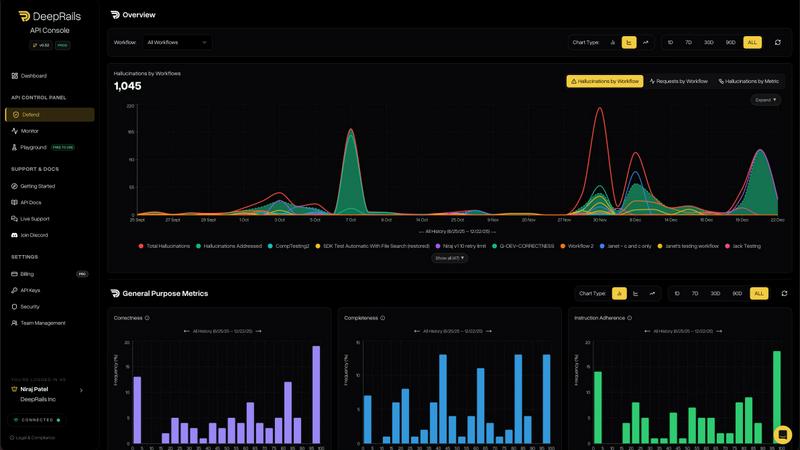
DeepRails is the definitive guardrails platform engineered to solve the single biggest problem in production AI: hallucinations. It's built for developers and engineering teams who are serious about shipping trustworthy, reliable AI applications and refuse to accept "making things up" as an unavoidable cost of innovation. While other tools might simply flag a potential issue, DeepRails is the only solution designed to both hyper-accurately identify hallucinations and then substantively fix them in real-time. The platform provides a comprehensive suite for AI quality control, enabling teams to evaluate outputs for factual correctness, grounding, reasoning, and safety with industry-leading precision. Beyond detection, its automated remediation workflows and human-in-the-loop feedback systems actively improve model behavior. DeepRails is model-agnostic, production-ready, and integrates seamlessly into modern development pipelines, giving teams the confidence to deploy AI at scale without compromising on reliability or user trust.
Alternatives
AutomagicWP Alternatives
AutomagicWP is a developer tool that transforms how you distribute and update WordPress plugins and themes. It belongs to the category of automated deployment and update management solutions, designed to eliminate the tedious manual process of logging into multiple client sites. By handling distribution through WordPress's native update system, it brings a professional, hands-off experience to managing a portfolio of sites. Users often explore alternatives for various reasons. Some might need a different pricing model or a specific feature not offered, while others may require deeper integration with their existing commerce or CI/CD platform. The needs of a solo developer differ from those of a large agency, so flexibility and scale are key considerations. When evaluating an alternative, focus on core workflow efficiency. Look for solutions that automate the actual update delivery, maintain a professional presentation within the WordPress admin, and offer automation hooks like APIs or GitHub integrations. The goal is to permanently escape the repetitive "ZIP loop" and reclaim valuable development time.
DeepRails Alternatives
DeepRails is a cutting-edge AI reliability platform in the developer tools category, designed to help teams build trustworthy AI systems. It goes beyond simple detection by actively fixing hallucinations and incorrect outputs from large language models. Teams often explore alternatives for various reasons, such as specific budget constraints, the need for different integration capabilities, or a focus on particular feature sets like monitoring versus active correction. The landscape of AI guardrail tools is evolving rapidly. When evaluating options, it's crucial to look for solutions that not only identify issues but also provide substantive fixes. Key considerations include the accuracy of detection, the availability of automated remediation workflows, model-agnostic support, and tools that align evaluation metrics with your specific business objectives.