
DeepRails vs qtrl.ai

Last updated: February 28, 2026

qtrl.ai
qtrl scales your QA from test management to autonomous AI agents without losing control.
Last updated: February 27, 2026
Visual Comparison
DeepRails
qtrl.ai
Feature Comparison
DeepRails
Defend API - The Real-Time Correction Engine
Defend API is your proactive shield against flawed AI outputs. It acts as a middleware layer that intercepts your LLM's response, runs it through a configurable suite of guardrail metrics (like Correctness or Context Adherence), and can automatically fix issues before the response reaches your user. Using actions like "FixIt" or "ReGen," it can correct hallucinations, add missing citations, or even regenerate a compliant response, turning a potential error into a trustworthy interaction in milliseconds.
Expansive & Custom Guardrail Metrics Library
Move beyond basic moderation with a deep library of specialized evaluation metrics. Choose from purpose-built metrics like Correctness for factual accuracy, Completeness for answering all query parts, and Context Adherence for RAG systems. Each metric provides a granular 0-100 score and is benchmarked to be significantly more accurate than alternatives. You can also create fully custom metrics aligned with your specific business logic and domain requirements for unparalleled control.
DeepRails Console with Full Audit Trails
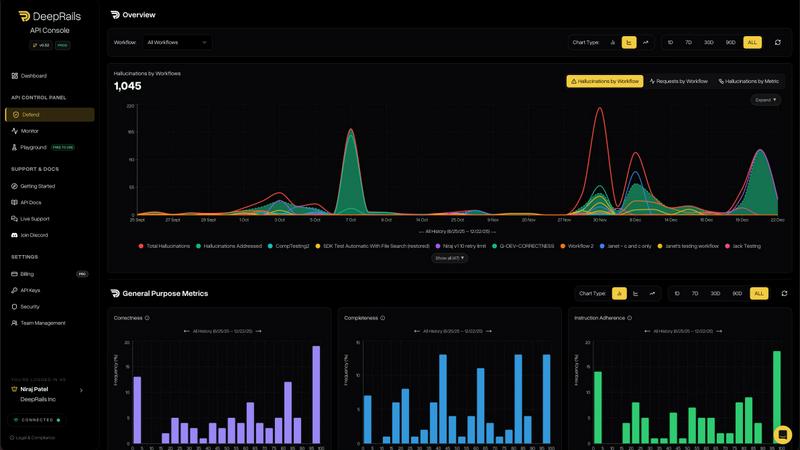
Gain complete visibility into your AI's performance with the DeepRails Console. Every interaction—from your LLM, through DeepRails' evaluation and remediation, to the final customer—is logged in real-time. The console provides beautiful dashboards for key metrics, detailed traces of every "improvement chain" where a fix was applied, and full audit logs. This turns AI reliability from a black box into a transparent, measurable, and improvable system.
Automated Remediation & Improvement Workflows
DeepRails doesn't just tell you what's wrong; it helps you make it right. Configure automated workflows that trigger specific actions when a guardrail threshold is breached. This can include sending the output for human review, invoking a tool to fetch correct data, or instructing the model to regenerate its answer. These continuous feedback loops ensure your AI systems actively learn and improve their behavior over time, directly from production data.
qtrl.ai
Autonomous QA Agents
This is where qtrl's AI layer truly shines. Built-in autonomous agents can generate robust UI tests directly from natural language descriptions, maintain them as your application evolves, and execute them at scale across multiple browsers and environments. They operate on-demand or continuously, following your defined rules and executing in real browsers—not simulations—for authentic results. This feature transforms test creation from a coding task into a strategic conversation.
Enterprise-Grade Test Management
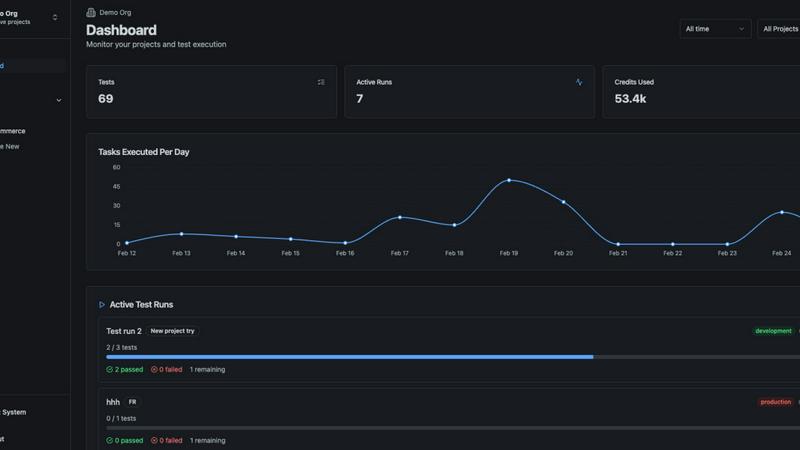
qtrl provides a centralized command center for all your QA activities. Organize test cases, plan and execute test runs, and maintain full traceability from requirements to coverage. The platform supports both manual and automated workflows and is built with compliance and auditability in mind, creating complete audit trails for every action. It’s the solid foundation of structure and oversight that makes advanced automation safe.
Progressive Automation Model
This isn't an all-or-nothing AI gamble. qtrl's progressive model lets you start with human-written test instructions. As confidence grows, you can move to AI-generated tests, with full review and approval at every step. The platform even analyzes coverage gaps and suggests new tests to fill them. You control the pace, increasing autonomy only when it proves its value, ensuring trust is earned, not assumed.
Governance by Design & Adaptive Memory
qtrl is built for enterprise trust. It offers permissioned autonomy levels, full visibility into agent actions, and enterprise-ready security, ensuring no black-box decisions. Coupled with its Adaptive Memory, which builds a living knowledge base of your application from every interaction, qtrl gets smarter and more context-aware over time while always operating within your governance framework.
Use Cases
DeepRails
Legal & Compliance AI Assistants
Ensure every legal citation, case reference, and piece of advice is factually verifiable and grounded in provided documentation. DeepRails' Correctness and Context Adherence metrics prevent AI from inventing non-existent statutes or misinterpreting precedent, which is critical for maintaining professional integrity and avoiding liability in sensitive legal, financial, and compliance applications.
Healthcare and Medical Information Bots
Safeguard patient interactions by rigorously verifying medical information, drug interaction lists, and treatment advice against trusted sources. DeepRails can detect and correct subtle factual hallucinations, ensuring that AI-powered health support tools provide only accurate, grounded information and filter out unsafe or unverified content, protecting user well-being.
Robust RAG (Retrieval-Augmented Generation) Systems
Supercharge your RAG pipelines by guaranteeing that every factual claim in the AI's answer is directly supported by the retrieved context. The Context Adherence metric acts as a final verification layer, catching instances where the model might "go rogue" and insert its own knowledge or assumptions, thereby ensuring the system remains a reliable channel for your proprietary data.
Customer Support and Brand Interaction Chatbots
Maintain brand consistency and quality by enforcing instruction adherence for tone, style, and format. Ensure complex, multi-part customer queries are answered completely and that responses never leak sensitive PII or generate harmful content. This allows customer-facing AI to be both helpful and perfectly on-brand, building trust with every interaction.
qtrl.ai
Scaling Beyond Manual Testing
For QA teams overwhelmed by repetitive manual checks, qtrl provides a clear path forward. Start by structuring manual test cases in the platform, then gradually introduce AI agents to automate the most tedious flows. This allows teams to scale test coverage and frequency without linearly increasing headcount, freeing human testers for more complex, exploratory work.
Modernizing Legacy QA Workflows
Companies stuck with outdated, script-heavy automation suites can use qtrl to break free from maintenance hell. The AI agents can generate new, maintainable tests from natural language, and the adaptive memory helps understand the application context. This enables a gradual migration to a more intelligent and resilient automation strategy without a risky, full-scale rewrite.
Ensuring Governance in Autonomous QA
Enterprises that require strict compliance, traceability, and audit trails can safely explore AI-powered testing with qtrl. The platform's governance-by-design approach provides permission controls, full audit logs, and the ability to review and approve every AI-generated test before it runs. This makes autonomous QA viable for regulated industries.
Accelerating Product-Led Engineering Teams
Fast-moving product teams need quality to keep pace with development. qtrl integrates with CI/CD pipelines and requirements management tools, creating continuous quality feedback loops. AI agents can execute tests across multiple environments per commit, giving developers immediate confidence and reducing the bottleneck on dedicated QA resources.
Overview
About DeepRails
DeepRails is the definitive guardrails platform engineered to solve the single biggest problem in production AI: hallucinations. It's built for developers and engineering teams who are serious about shipping trustworthy, reliable AI applications and refuse to accept "making things up" as an unavoidable cost of innovation. While other tools might simply flag a potential issue, DeepRails is the only solution designed to both hyper-accurately identify hallucinations and then substantively fix them in real-time. The platform provides a comprehensive suite for AI quality control, enabling teams to evaluate outputs for factual correctness, grounding, reasoning, and safety with industry-leading precision. Beyond detection, its automated remediation workflows and human-in-the-loop feedback systems actively improve model behavior. DeepRails is model-agnostic, production-ready, and integrates seamlessly into modern development pipelines, giving teams the confidence to deploy AI at scale without compromising on reliability or user trust.
About qtrl.ai
qtrl.ai is the modern QA platform that shatters the old trade-off between control and speed. It’s built for engineering and QA teams who are tired of choosing between slow, manual processes and brittle, expensive automation. qtrl brings enterprise-grade test management, intelligent automation, and autonomous AI agents into a single, cohesive platform. Its core value proposition is a progressive automation model: you can start with simple, structured test management on day one and gradually introduce AI-assisted and fully autonomous testing as your team is ready. This makes it perfect for product-led engineering teams, scaling QA departments, and enterprises that need robust governance without sacrificing velocity. qtrl provides clear visibility into quality through real-time dashboards, traces requirements to coverage, and turns every test run into structured data for smarter decision-making. It’s not just another tool; it’s a strategic upgrade designed to scale quality intelligently and sustainably.
Frequently Asked Questions
DeepRails FAQ
How does DeepRails' accuracy compare to other services?
DeepRails is built for precision. Our core metrics are independently benchmarked and significantly outperform generalized alternatives. For example, our Correctness metric is 45% more accurate than AWS Bedrock's for factual evaluation, and our Completeness metric is 53% more accurate. This high precision reduces false positives and ensures you're only fixing real problems.
Can DeepRails work with any LLM or AI model?
Absolutely. DeepRails is designed to be completely model-agnostic. It integrates seamlessly with all leading LLM providers (like OpenAI, Anthropic, Google) and can evaluate outputs from any model, including open-source ones. It fits into your existing stack as a middleware layer, making it easy to add guardrails without changing your core AI infrastructure.
What does "fixing" a hallucination actually involve?
DeepRails offers several automated remediation actions. "FixIt" can edit the existing output to correct the inaccurate claim. "ReGen" can instruct your LLM to regenerate a new response with specific guidance to avoid the error. Other actions include routing to a human, invoking a web search for verification, or triggering a custom function. You configure the best action for each guardrail.
Is DeepRails suitable for monitoring production traffic?
Yes, DeepRails is built for production from the ground up. The Defend API handles real-time evaluation and correction at low latency. The companion Monitor API (part of the suite) is designed for high-volume logging, evaluation, and analytics of production traffic without being in the critical response path, giving you comprehensive observability.
qtrl.ai FAQ
How does qtrl's AI handle changes in my application's UI?
qtrl's autonomous agents are coupled with an Adaptive Memory system that learns from your application. When the UI evolves, the AI uses this context to understand the changes and can automatically update the affected test steps, significantly reducing maintenance overhead compared to traditional coded scripts. All changes are suggested for review before being applied.
Is my test data and application access secure with an AI agent?
Absolutely. Security is foundational. qtrl operates with enterprise-ready security protocols. For executions, you can use per-environment variables and encrypted secrets, which are never exposed to the AI agent. The system is designed to execute tests without retaining sensitive data, and all access is governed by strict permission controls.
Do I need to be an automation expert to use qtrl?
Not at all! qtrl is designed for progression. You can start by using it as a powerful test management tool with no automation. When you're ready, you can begin by writing simple, natural language instructions for the AI to execute. The platform guides you toward more advanced automation as your team's comfort and needs grow.
Can I integrate qtrl with my existing tools and pipelines?
Yes, qtrl is built for real workflows. It offers integrations for requirements management and full support for CI/CD pipelines. This allows you to trigger test runs automatically from your build processes and feed quality metrics back into your development lifecycle, creating seamless feedback loops without disrupting your current toolkit.
Alternatives
DeepRails Alternatives
DeepRails is a cutting-edge AI reliability platform in the developer tools category, designed to help teams build trustworthy AI systems. It goes beyond simple detection by actively fixing hallucinations and incorrect outputs from large language models. Teams often explore alternatives for various reasons, such as specific budget constraints, the need for different integration capabilities, or a focus on particular feature sets like monitoring versus active correction. The landscape of AI guardrail tools is evolving rapidly. When evaluating options, it's crucial to look for solutions that not only identify issues but also provide substantive fixes. Key considerations include the accuracy of detection, the availability of automated remediation workflows, model-agnostic support, and tools that align evaluation metrics with your specific business objectives.
qtrl.ai Alternatives
qtrl.ai is a modern QA test management and automation platform designed for product development teams. It combines structured test case management with an advanced AI layer that can generate, maintain, and execute tests autonomously, helping teams scale their quality assurance from manual processes to full automation. Teams often explore alternatives for various reasons, such as budget constraints, specific integration needs, or a desire for a different feature mix. Some may prioritize pure open-source tools, while others might seek a platform with a stronger focus on performance or security testing outside of qtrl.ai's core UI automation strengths. When evaluating other options, consider your team's automation maturity, the need for AI-assisted test creation, and how deeply you require requirements tracing and real-time dashboards. The ideal platform should grow with you, offering a clear path from manual test management to intelligent, autonomous QA execution.