
DeepRails vs Requestly

Last updated: February 28, 2026

Last updated: March 26, 2026
Visual Comparison
DeepRails
Requestly
Feature Comparison
DeepRails
Defend API - The Real-Time Correction Engine
Defend API is your proactive shield against flawed AI outputs. It acts as a middleware layer that intercepts your LLM's response, runs it through a configurable suite of guardrail metrics (like Correctness or Context Adherence), and can automatically fix issues before the response reaches your user. Using actions like "FixIt" or "ReGen," it can correct hallucinations, add missing citations, or even regenerate a compliant response, turning a potential error into a trustworthy interaction in milliseconds.
Expansive & Custom Guardrail Metrics Library
Move beyond basic moderation with a deep library of specialized evaluation metrics. Choose from purpose-built metrics like Correctness for factual accuracy, Completeness for answering all query parts, and Context Adherence for RAG systems. Each metric provides a granular 0-100 score and is benchmarked to be significantly more accurate than alternatives. You can also create fully custom metrics aligned with your specific business logic and domain requirements for unparalleled control.
DeepRails Console with Full Audit Trails
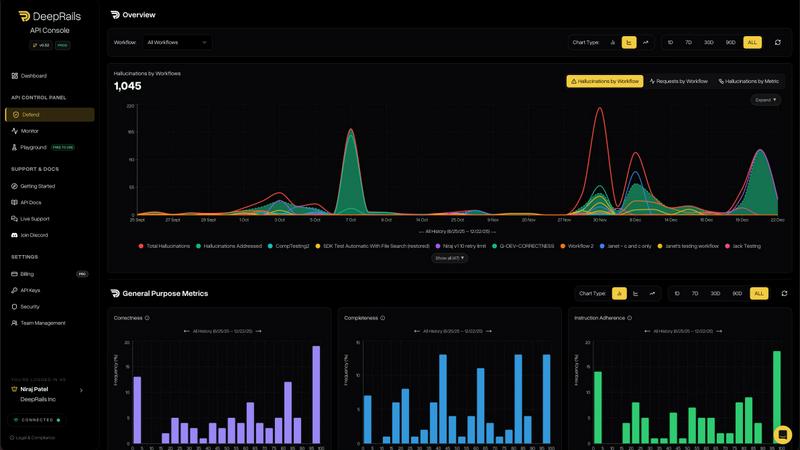
Gain complete visibility into your AI's performance with the DeepRails Console. Every interaction—from your LLM, through DeepRails' evaluation and remediation, to the final customer—is logged in real-time. The console provides beautiful dashboards for key metrics, detailed traces of every "improvement chain" where a fix was applied, and full audit logs. This turns AI reliability from a black box into a transparent, measurable, and improvable system.
Automated Remediation & Improvement Workflows
DeepRails doesn't just tell you what's wrong; it helps you make it right. Configure automated workflows that trigger specific actions when a guardrail threshold is breached. This can include sending the output for human review, invoking a tool to fetch correct data, or instructing the model to regenerate its answer. These continuous feedback loops ensure your AI systems actively learn and improve their behavior over time, directly from production data.
Requestly
Git-Native Collections
Requestly allows you to store your API collections as local files that can easily be managed through Git. This feature enables you to version control your API workflows, branch out for new features, and collaborate seamlessly with your team, just like you would with your source code.
AI-Enhanced Request Writing
Leverage the power of AI to streamline your API development. Requestly's built-in intelligence assists developers in crafting requests, generating tests, and debugging APIs more efficiently, allowing for a smoother development experience and less time spent on manual tasks.
Multi-Workspace Management
Easily manage multiple local workspaces simultaneously with Requestly's multi-workspace view. This feature enhances productivity by allowing developers to switch contexts quickly and organize their API projects without the hassle of cloud storage.
Comprehensive Authorization Management
Requestly provides a centralized interface for managing authorization details, enabling you to organize them at both the collection and request levels. This makes it easy to handle various authentication methods, ensuring secure access to your APIs without complications.
Use Cases
DeepRails
Legal & Compliance AI Assistants
Ensure every legal citation, case reference, and piece of advice is factually verifiable and grounded in provided documentation. DeepRails' Correctness and Context Adherence metrics prevent AI from inventing non-existent statutes or misinterpreting precedent, which is critical for maintaining professional integrity and avoiding liability in sensitive legal, financial, and compliance applications.
Healthcare and Medical Information Bots
Safeguard patient interactions by rigorously verifying medical information, drug interaction lists, and treatment advice against trusted sources. DeepRails can detect and correct subtle factual hallucinations, ensuring that AI-powered health support tools provide only accurate, grounded information and filter out unsafe or unverified content, protecting user well-being.
Robust RAG (Retrieval-Augmented Generation) Systems
Supercharge your RAG pipelines by guaranteeing that every factual claim in the AI's answer is directly supported by the retrieved context. The Context Adherence metric acts as a final verification layer, catching instances where the model might "go rogue" and insert its own knowledge or assumptions, thereby ensuring the system remains a reliable channel for your proprietary data.
Customer Support and Brand Interaction Chatbots
Maintain brand consistency and quality by enforcing instruction adherence for tone, style, and format. Ensure complex, multi-part customer queries are answered completely and that responses never leak sensitive PII or generate harmful content. This allows customer-facing AI to be both helpful and perfectly on-brand, building trust with every interaction.
Requestly
Quick API Testing
With Requestly, developers can swiftly test APIs without the overhead of complex setups. The intuitive interface allows for rapid request creation and testing, making it ideal for developers who need immediate results during the development cycle.
Team Collaboration on API Projects
Requestly's shared workspace feature enables teams to collaborate on API projects effortlessly. Team members can work together in real-time, share collections, and manage changes, enhancing productivity and ensuring everyone is on the same page.
Migration from Postman
For teams transitioning from Postman, Requestly offers a one-click import feature that allows users to migrate their collections and environments seamlessly. This makes switching to Requestly easy and hassle-free, ensuring no loss of productivity during the transition.
API Documentation and Debugging
Utilize Requestly to maintain comprehensive documentation of your APIs while also debugging them effectively. The built-in logging features keep track of API calls, allowing developers to review and resolve issues quickly, which enhances overall API reliability.
Overview
About DeepRails
DeepRails is the definitive guardrails platform engineered to solve the single biggest problem in production AI: hallucinations. It's built for developers and engineering teams who are serious about shipping trustworthy, reliable AI applications and refuse to accept "making things up" as an unavoidable cost of innovation. While other tools might simply flag a potential issue, DeepRails is the only solution designed to both hyper-accurately identify hallucinations and then substantively fix them in real-time. The platform provides a comprehensive suite for AI quality control, enabling teams to evaluate outputs for factual correctness, grounding, reasoning, and safety with industry-leading precision. Beyond detection, its automated remediation workflows and human-in-the-loop feedback systems actively improve model behavior. DeepRails is model-agnostic, production-ready, and integrates seamlessly into modern development pipelines, giving teams the confidence to deploy AI at scale without compromising on reliability or user trust.
About Requestly
Requestly is a cutting-edge API client tailored for modern development teams seeking enhanced control over their API workflows. Unlike traditional tools like Postman, Requestly is a lightweight, local-first solution that prioritizes data privacy by keeping all information securely on your machine. This innovative approach allows teams to manage their API collections using git, enabling version control, branching, and collaborative efforts akin to software development practices. With an AI-native framework, Requestly accelerates the process of writing requests, generating tests, and debugging APIs, making it a must-have for developers. It supports both REST and GraphQL protocols, offering features like schema introspection and environment variables. Furthermore, Requestly stands out with its generous free-tier offerings, including shared workspaces, role-based access, and seamless Postman migration—all without requiring any login to get started. Trusted by over 300,000 developers from leading companies like Microsoft, Amazon, Google, and Adobe, Requestly is revolutionizing the way developers interact with APIs.
Frequently Asked Questions
DeepRails FAQ
How does DeepRails' accuracy compare to other services?
DeepRails is built for precision. Our core metrics are independently benchmarked and significantly outperform generalized alternatives. For example, our Correctness metric is 45% more accurate than AWS Bedrock's for factual evaluation, and our Completeness metric is 53% more accurate. This high precision reduces false positives and ensures you're only fixing real problems.
Can DeepRails work with any LLM or AI model?
Absolutely. DeepRails is designed to be completely model-agnostic. It integrates seamlessly with all leading LLM providers (like OpenAI, Anthropic, Google) and can evaluate outputs from any model, including open-source ones. It fits into your existing stack as a middleware layer, making it easy to add guardrails without changing your core AI infrastructure.
What does "fixing" a hallucination actually involve?
DeepRails offers several automated remediation actions. "FixIt" can edit the existing output to correct the inaccurate claim. "ReGen" can instruct your LLM to regenerate a new response with specific guidance to avoid the error. Other actions include routing to a human, invoking a web search for verification, or triggering a custom function. You configure the best action for each guardrail.
Is DeepRails suitable for monitoring production traffic?
Yes, DeepRails is built for production from the ground up. The Defend API handles real-time evaluation and correction at low latency. The companion Monitor API (part of the suite) is designed for high-volume logging, evaluation, and analytics of production traffic without being in the critical response path, giving you comprehensive observability.
Requestly FAQ
What is Requestly and how does it differ from Postman?
Requestly is a lightweight API client designed for modern developers, offering a local-first approach that stores data on your machine. Unlike Postman, it emphasizes collaboration through git-based collections and does not require a login to start using it.
Can I use Requestly for GraphQL APIs?
Yes, Requestly supports GraphQL APIs, providing features like schema introspection and auto-completion, making it easier for developers to work with GraphQL endpoints efficiently.
How does Requestly ensure data privacy?
Requestly prioritizes data privacy by keeping all API data stored locally on your machine rather than in the cloud, ensuring that your sensitive information remains secure and under your control.
Is there a free version of Requestly available?
Absolutely! Requestly offers a generous free tier that includes team collaboration features, shared workspaces, and the ability to import from Postman, making it accessible for developers without any upfront costs.
Alternatives
DeepRails Alternatives
DeepRails is a cutting-edge AI reliability platform in the developer tools category, designed to help teams build trustworthy AI systems. It goes beyond simple detection by actively fixing hallucinations and incorrect outputs from large language models. Teams often explore alternatives for various reasons, such as specific budget constraints, the need for different integration capabilities, or a focus on particular feature sets like monitoring versus active correction. The landscape of AI guardrail tools is evolving rapidly. When evaluating options, it's crucial to look for solutions that not only identify issues but also provide substantive fixes. Key considerations include the accuracy of detection, the availability of automated remediation workflows, model-agnostic support, and tools that align evaluation metrics with your specific business objectives.
Requestly Alternatives
Requestly is a local-first, git-driven API client that empowers modern development teams by providing them with complete control over their API workflows. Unlike traditional cloud-based solutions, Requestly stores data locally, allowing users to manage API collections as files that can be versioned, branched, and collaborated on through git, just like code. This innovative tool is designed to enhance productivity for developers by offering features tailored to streamline the API development process. Users often seek alternatives to tools like Requestly for various reasons, including pricing structures, specific feature sets, or compatibility with their preferred platforms. When exploring alternatives, it is essential to consider factors such as ease of use, collaboration capabilities, support for different API types, and the overall flexibility of the tool. A good alternative should not only meet current needs but also scale as your development processes evolve.