
Fallom vs Playwriter

Fallom
Experience real-time observability for AI agents with Fallom, enabling quick tracing and insightful analysis in minutes.
Last updated: February 28, 2026

Last updated: March 18, 2026
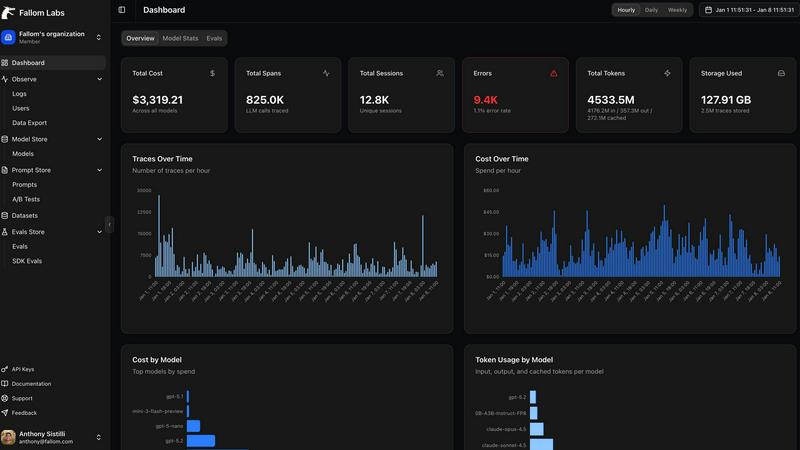
Visual Comparison
Fallom
Playwriter

Feature Comparison
Fallom
Real-Time Observability
Fallom provides real-time observability for AI agents, allowing users to track tool calls, analyze timing, and debug with confidence. With live monitoring of each LLM call, teams can quickly identify and resolve issues, ensuring optimal performance of their AI applications.
Cost Attribution
Gain full transparency into your AI expenditures with Fallom's cost attribution feature. Track spending per model, user, and team, enabling precise budgeting and chargeback processes. This feature is crucial for organizations aiming to manage their AI expenses effectively.
Compliance Ready
Fallom is built with compliance in mind, offering complete audit trails to support regulatory requirements. Features like input/output logging, model versioning, and user consent tracking ensure that organizations can stay compliant with regulations such as GDPR and SOC 2, providing peace of mind.
Timing Waterfall Analysis
Debug latency issues in complex multi-step agent workflows using Fallom's timing waterfall feature. This tool helps visualize the time taken for each function call and the overall response time, enabling teams to optimize workflows and enhance user experience.
Playwriter
Your Real Browser Session
Playwriter doesn't spawn a new, sterile browser. It attaches directly to your existing Chrome tabs via a debugger connection. This means every website you're already logged into—Gmail, GitHub, admin dashboards—is instantly available to your AI agent. Your extensions (like password managers or ad blockers) are active, and your cookies are present, completely bypassing the bot detection that plagues fresh, headless instances. It's browsing with your identity, without the overhead.
Full Playwright API Through a Single Tool
Instead of limiting agents to a fixed set of pre-defined tools (like "click" or "type"), Playwriter exposes one powerful execute tool. Your agent can run any valid Playwright code, unlocking the entire automation library: complex selectors, network interception, performance profiling, and setting breakpoints. This keeps the AI's context window lean by avoiding schema bloat from dozens of tool definitions and grants unparalleled flexibility.
Advanced Debugging & Collaboration Suite
Playwriter is built for real-world debugging and human-AI teamwork. It includes a live debugger with breakpoints, live code editing, and network request interception. You can watch the agent work in real-time on your screen. When it hits a CAPTCHA or a consent wall, you simply solve it and let the agent continue. If it gets stuck, you can temporarily disable control, fix the page manually, and re-enable it—seamless collaboration.
Lightweight Accessibility Snapshots & Recording
Forget massive, context-consuming screenshots. Playwriter generates compact accessibility snapshots (only 5-20KB) that provide the AI with a structured, semantic view of the page. It also includes visual labeling for elements and can record full video of the agent's session. Combined with network interception, this gives your AI deep, efficient insight into page state and behavior.
Use Cases
Fallom
Debugging AI Applications
Fallom is invaluable for development teams looking to debug AI applications. By providing detailed tracing of LLM calls and tool interactions, teams can quickly pinpoint bottlenecks and improve the efficiency of their AI solutions.
Cost Management for AI Workloads
Organizations can utilize Fallom to manage and attribute costs associated with LLM usage effectively. This is essential for teams needing to allocate budgets accurately and understand spending patterns across different models and user groups.
Regulatory Compliance
Fallom assists companies in meeting stringent compliance requirements by providing complete audit trails and user consent tracking. This feature is especially beneficial for industries that must adhere to regulations such as the EU AI Act and GDPR.
Performance Monitoring
With Fallom’s real-time monitoring capabilities, companies can keep a close eye on AI performance. By spotting anomalies and performance dips early, teams can take proactive measures to ensure their AI systems are running smoothly and efficiently.
Playwriter
Automated Web Testing & Debugging
Developers can instruct their AI assistant to run complex, multi-step user flows on their already-logged-in development or staging environments. The agent can click through UIs, fill forms, intercept API calls to verify payloads, and profile performance—all within the exact browser context a real user would have, making tests more reliable and context-aware.
AI-Powered Research & Data Extraction
Researchers and analysts can task an AI with gathering information from websites that require login or have complex interactive elements. Since Playwriter uses the real browser, it can navigate paywalls, logged-in databases, and JavaScript-heavy dashboards that are completely inaccessible to traditional, headless agent tools.
Routine Task Automation
Automate repetitive daily web tasks without writing a single line of code yourself. Have your AI agent log in to platforms, generate reports, schedule posts, or monitor status pages. Because it works in your browser session, it can handle two-factor authentication flows where you approve the login prompt.
Enhanced AI Assistant Capabilities
Supercharge coding assistants like Cursor or Claude. Instead of just writing hypothetical code, your AI can now execute Playwright scripts to interact with live documentation, pull examples from a web API, test a component in Storybook, or even debug a live web application by manipulating the DOM and inspecting network traffic in real-time.
Overview
About Fallom
Fallom is the cutting-edge AI-native observability platform specifically designed for Large Language Model (LLM) and agent workloads. It empowers teams to gain a comprehensive view of every LLM call made in production, providing end-to-end tracing of essential metrics including prompts, outputs, tool calls, tokens, latency, and cost per call. Tailored for organizations managing complex AI systems, Fallom offers session, user, and customer-level context, allowing for detailed insight into AI interactions. Its enterprise-ready features include robust audit trails, model versioning, and consent tracking, ensuring compliance with regulations such as GDPR and the EU AI Act. With its single OpenTelemetry-native SDK, teams can seamlessly instrument their applications in just minutes, enabling real-time monitoring, faster debugging, and precise cost attribution across models, users, and teams. Fallom is the essential tool for organizations looking to harness the full potential of AI while maintaining control and visibility.
About Playwriter
Stop fighting with headless browsers and bot detection. Playwriter is the game-changing bridge that lets your AI agents operate directly within your real, logged-in Chrome browser. It's a Chrome extension and CLI that gives any MCP client (like Cursor, Claude Desktop, or VS Code) the full power of the Playwright automation API, but executed in your existing browser session. This means your agents have immediate access to all your extensions, cookies, and logins—no fresh Chrome instance, no extra memory load, and no instant red flags from websites. It turns the brittle, limited browsing of today's AI into a seamless, powerful, and collaborative experience. Built for developers, researchers, and power users who need their AI assistants to interact with the modern web as a human would, Playwriter is open-source (MIT licensed) and runs entirely locally on your machine, putting you in full control.
Frequently Asked Questions
Fallom FAQ
How quickly can I set up Fallom?
Setting up Fallom is incredibly fast and efficient. With the OpenTelemetry-native SDK, you can instrument your applications in under five minutes, enabling immediate access to monitoring and tracing functionalities.
What compliance regulations does Fallom support?
Fallom is designed to help organizations adhere to various compliance regulations, including the EU AI Act, GDPR, and SOC 2. With features like audit trails and consent tracking, Fallom ensures you stay compliant in a regulatory landscape.
Can Fallom be used with any AI provider?
Absolutely! Fallom’s OpenTelemetry native SDK is compatible with all AI providers, ensuring you have the flexibility to choose the best tools for your needs without the worry of vendor lock-in.
What kind of analytics can I expect from Fallom?
Fallom provides in-depth analytics related to LLM usage, including cost attribution, user engagement metrics, and performance monitoring. This data helps teams make informed decisions about AI deployments and resource allocation.
Playwriter FAQ
Is my browsing data sent to a remote server?
No. Playwriter is designed with privacy and security first. All communication happens via a WebSocket relay running on localhost:19988 on your own machine. The Chrome extension, CLI, and your AI client communicate directly with this local relay. No browsing data, credentials, or session cookies are ever transmitted to any remote server.
How does Playwriter avoid bot detection?
It avoids detection by not acting like a typical bot. It controls your genuine, user-initiated Chrome browser session, which already has a normal history, cookies, and likely some browser extensions installed. This fingerprint matches that of a regular human user, unlike a fresh, headless Chrome instance which lacks these signals and is easily flagged.
Can I use it with any AI or just specific MCP clients?
Playwriter works with any client that supports the Model Context Protocol (MCP), which is becoming a standard for AI tool integration. This includes popular environments like Cursor, Claude Desktop, VS Code with extensions, and more. The provided skill teaches these clients how to use Playwriter effectively.
What happens if the AI gets stuck or makes a mistake?
This is where the collaboration features shine. You watch the actions happen live in your browser. If the agent enters an error state or gets stuck in a loop, you can immediately click the extension icon to detach it from that tab (turning it gray), manually correct the situation, and then re-attach control. The agent can then continue from the corrected state.
Alternatives
Fallom Alternatives
Fallom is a cutting-edge AI-native observability platform designed specifically for LLM and agent workloads. It empowers teams to gain unparalleled insights into every LLM call made in production, offering comprehensive end-to-end tracing that captures prompts, outputs, tool calls, and more. As organizations increasingly adopt AI technologies, users often seek alternatives due to varying needs such as pricing, feature sets, and specific platform requirements. An ideal alternative should not only meet budgetary constraints but also provide robust functionalities, seamless integration capabilities, and the flexibility to scale as your projects evolve. When exploring alternatives to Fallom, consider essential factors like user experience, the breadth of monitoring features, and ease of implementation. Look for platforms that offer comprehensive analytics, compliance support, and real-time debugging capabilities. Additionally, ensure that the alternative can accommodate your specific use cases and is adaptable to the changing landscape of AI observability.
Playwriter Alternatives
Playwriter is a developer tool that bridges AI agents directly to your real browser session. It solves the core problem of AI automation by providing access to your actual logged-in state, extensions, and settings, instead of a fresh, empty browser that gets instantly flagged. Developers often look for alternatives for various reasons. They might need different pricing models, require specific integrations with other tools in their stack, or be looking for a particular feature set that matches their unique workflow. The landscape of browser automation and AI agent tools is constantly evolving. When evaluating options, consider the core capability of session persistence, the depth of debugging and control features, compatibility with your preferred AI clients and IDEs, and the overall philosophy of the project regarding openness, security, and extensibility. The right tool should feel like a natural extension of your development process.