
Fusedash vs qtrl.ai
Fusedash
Fusedash transforms your data into interactive dashboards, charts, and reports for quick insights and seamless.
Last updated: March 3, 2026
qtrl.ai
qtrl scales your QA from test management to autonomous AI agents without losing control.
Last updated: February 27, 2026
Visual Comparison
Fusedash

qtrl.ai
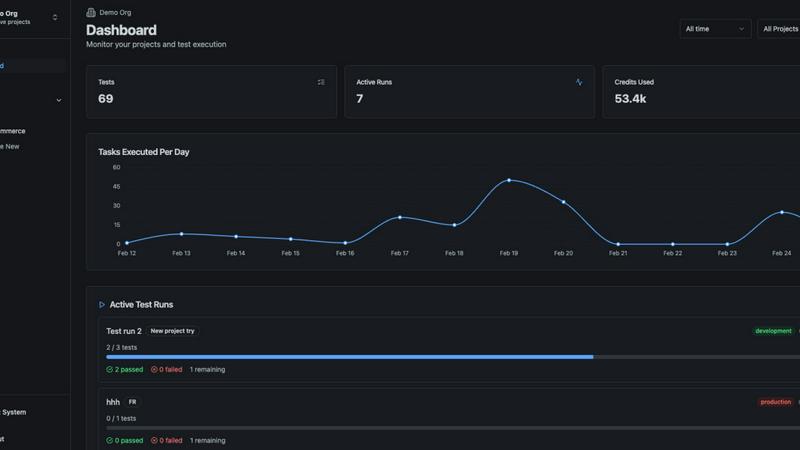
Feature Comparison
Fusedash
Flexible Views
Fusedash offers the ability to create tailored dashboards, charts, and maps from the same dataset, enabling teams to present information in the most relevant format for their audience. This feature minimizes the need for back-and-forth communication, streamlining the decision-making process.
AI Chart Generator
With the AI Chart Generator, users can create powerful visuals from CSVs or APIs in mere minutes. This tool helps choose the best chart type, apply comparisons, and label data accurately, ensuring that the story behind the data is communicated effectively.
Dashboard Software
Fusedash combines dashboards and reporting in one unified workspace, allowing teams to present key performance indicators alongside narrative insights. This integration ensures that all stakeholders understand the context of the data, fostering alignment and reducing discrepancies in reporting.
AI Chat
The Smart Chat feature empowers users to engage with their data using natural language. This interactive tool assists in exploring breakdowns and generating suggestions for metrics and charts, making data insights more accessible and shareable across teams.
qtrl.ai
Autonomous QA Agents
This is where qtrl's AI layer truly shines. Built-in autonomous agents can generate robust UI tests directly from natural language descriptions, maintain them as your application evolves, and execute them at scale across multiple browsers and environments. They operate on-demand or continuously, following your defined rules and executing in real browsers—not simulations—for authentic results. This feature transforms test creation from a coding task into a strategic conversation.
Enterprise-Grade Test Management
qtrl provides a centralized command center for all your QA activities. Organize test cases, plan and execute test runs, and maintain full traceability from requirements to coverage. The platform supports both manual and automated workflows and is built with compliance and auditability in mind, creating complete audit trails for every action. It’s the solid foundation of structure and oversight that makes advanced automation safe.
Progressive Automation Model
This isn't an all-or-nothing AI gamble. qtrl's progressive model lets you start with human-written test instructions. As confidence grows, you can move to AI-generated tests, with full review and approval at every step. The platform even analyzes coverage gaps and suggests new tests to fill them. You control the pace, increasing autonomy only when it proves its value, ensuring trust is earned, not assumed.
Governance by Design & Adaptive Memory
qtrl is built for enterprise trust. It offers permissioned autonomy levels, full visibility into agent actions, and enterprise-ready security, ensuring no black-box decisions. Coupled with its Adaptive Memory, which builds a living knowledge base of your application from every interaction, qtrl gets smarter and more context-aware over time while always operating within your governance framework.
Use Cases
Fusedash
KPI Review Dashboards
Fusedash is perfect for creating KPI review dashboards tailored for leadership teams. This allows executives to quickly visualize their performance metrics and understand the overall health of the organization without sifting through lengthy reports.
Marketing Performance Tracking
Marketers can utilize Fusedash to track campaign performance in real-time. By filtering data by product, region, or channel, teams can swiftly assess the impact of their marketing strategies and make data-driven adjustments on the fly.
Operations Monitoring
Operations teams benefit from Fusedash's real-time monitoring capabilities. By keeping an eye on fast-moving metrics, they can identify bottlenecks and inefficiencies, ensuring that operations run smoothly and effectively in a dynamic environment.
Geo Analysis with Map Visualizations
For teams needing geographic data insights, Fusedash's map visualizations offer a unique perspective. Users can overlay data on maps to analyze trends and performance by location, providing critical context that supports strategic decision-making.
qtrl.ai
Scaling Beyond Manual Testing
For QA teams overwhelmed by repetitive manual checks, qtrl provides a clear path forward. Start by structuring manual test cases in the platform, then gradually introduce AI agents to automate the most tedious flows. This allows teams to scale test coverage and frequency without linearly increasing headcount, freeing human testers for more complex, exploratory work.
Modernizing Legacy QA Workflows
Companies stuck with outdated, script-heavy automation suites can use qtrl to break free from maintenance hell. The AI agents can generate new, maintainable tests from natural language, and the adaptive memory helps understand the application context. This enables a gradual migration to a more intelligent and resilient automation strategy without a risky, full-scale rewrite.
Ensuring Governance in Autonomous QA
Enterprises that require strict compliance, traceability, and audit trails can safely explore AI-powered testing with qtrl. The platform's governance-by-design approach provides permission controls, full audit logs, and the ability to review and approve every AI-generated test before it runs. This makes autonomous QA viable for regulated industries.
Accelerating Product-Led Engineering Teams
Fast-moving product teams need quality to keep pace with development. qtrl integrates with CI/CD pipelines and requirements management tools, creating continuous quality feedback loops. AI agents can execute tests across multiple environments per commit, giving developers immediate confidence and reducing the bottleneck on dedicated QA resources.
Overview
About Fusedash
Fusedash is an innovative AI data visualization platform designed to transform connected data into actionable insights through intuitive dashboards, charts, maps, and narrative reports. Tailored for teams across various industries, Fusedash eliminates the hassle of rebuilding similar logic in multiple tools, allowing users to maintain consistent KPI definitions across different views. With features to filter by segment, region, product, or time, teams can effortlessly drill down into their data to understand the factors driving change. Fusedash’s AI capabilities enhance user experience by enabling natural language queries, quick summaries for stakeholders, and assistance in refining visualizations. Ideal for KPI reviews, marketing performance tracking, operations monitoring, and geo-analysis, Fusedash provides real-time interfaces to monitor fast-moving metrics, ensuring that decision-makers have the insights they need when minutes matter.
About qtrl.ai
qtrl.ai is the modern QA platform that shatters the old trade-off between control and speed. It’s built for engineering and QA teams who are tired of choosing between slow, manual processes and brittle, expensive automation. qtrl brings enterprise-grade test management, intelligent automation, and autonomous AI agents into a single, cohesive platform. Its core value proposition is a progressive automation model: you can start with simple, structured test management on day one and gradually introduce AI-assisted and fully autonomous testing as your team is ready. This makes it perfect for product-led engineering teams, scaling QA departments, and enterprises that need robust governance without sacrificing velocity. qtrl provides clear visibility into quality through real-time dashboards, traces requirements to coverage, and turns every test run into structured data for smarter decision-making. It’s not just another tool; it’s a strategic upgrade designed to scale quality intelligently and sustainably.
Frequently Asked Questions
Fusedash FAQ
What types of data can I connect to Fusedash?
Fusedash supports various data types, including CSV uploads, API connections, and integration with public data sources. This flexibility allows users to build comprehensive views by combining different datasets.
How does Fusedash ensure consistent KPI definitions?
Fusedash allows users to create and define KPIs and dimensions that can be reused across multiple dashboards, charts, and reports. This standardization ensures that all teams are aligned and reviewing the same key performance indicators.
Can I customize dashboards for different audiences?
Absolutely! Fusedash enables users to customize layouts, filters, and time ranges for different stakeholders. This means teams can present the same data in various formats tailored to their specific audience's needs.
Is Fusedash suitable for real-time data monitoring?
Yes, Fusedash offers real-time interfaces that allow teams to monitor fast-moving metrics effectively. This feature is crucial for businesses that need immediate insights to make timely decisions and respond to changing conditions.
qtrl.ai FAQ
How does qtrl's AI handle changes in my application's UI?
qtrl's autonomous agents are coupled with an Adaptive Memory system that learns from your application. When the UI evolves, the AI uses this context to understand the changes and can automatically update the affected test steps, significantly reducing maintenance overhead compared to traditional coded scripts. All changes are suggested for review before being applied.
Is my test data and application access secure with an AI agent?
Absolutely. Security is foundational. qtrl operates with enterprise-ready security protocols. For executions, you can use per-environment variables and encrypted secrets, which are never exposed to the AI agent. The system is designed to execute tests without retaining sensitive data, and all access is governed by strict permission controls.
Do I need to be an automation expert to use qtrl?
Not at all! qtrl is designed for progression. You can start by using it as a powerful test management tool with no automation. When you're ready, you can begin by writing simple, natural language instructions for the AI to execute. The platform guides you toward more advanced automation as your team's comfort and needs grow.
Can I integrate qtrl with my existing tools and pipelines?
Yes, qtrl is built for real workflows. It offers integrations for requirements management and full support for CI/CD pipelines. This allows you to trigger test runs automatically from your build processes and feed quality metrics back into your development lifecycle, creating seamless feedback loops without disrupting your current toolkit.
Alternatives
Fusedash Alternatives
Fusedash is an innovative analytics and data platform designed to transform connected data into decision-ready dashboards, charts, maps, and narrative reports. It enables teams to leverage consistent KPI definitions, facilitating the analysis of data across various segments, regions, and timeframes seamlessly. This product is particularly appealing for organizations seeking to streamline their data visualization processes and enhance decision-making capabilities. However, users may often seek alternatives to Fusedash for various reasons, including pricing, specific feature requirements, or the need for compatibility with existing platforms. When exploring alternatives, it's essential to consider the user experience, scalability, and the ability to integrate with other tools or datasets. A strong focus on real-time data monitoring and natural language querying can also significantly enhance the value of an alternative solution.
qtrl.ai Alternatives
qtrl.ai is a modern QA test management and automation platform designed for product development teams. It combines structured test case management with an advanced AI layer that can generate, maintain, and execute tests autonomously, helping teams scale their quality assurance from manual processes to full automation. Teams often explore alternatives for various reasons, such as budget constraints, specific integration needs, or a desire for a different feature mix. Some may prioritize pure open-source tools, while others might seek a platform with a stronger focus on performance or security testing outside of qtrl.ai's core UI automation strengths. When evaluating other options, consider your team's automation maturity, the need for AI-assisted test creation, and how deeply you require requirements tracing and real-time dashboards. The ideal platform should grow with you, offering a clear path from manual test management to intelligent, autonomous QA execution.