
Ark vs HookMesh

Ark
Ark is the white-label email API built for multi-tenant platforms like CRMs and helpdesks.
Last updated: February 28, 2026

Last updated: February 28, 2026
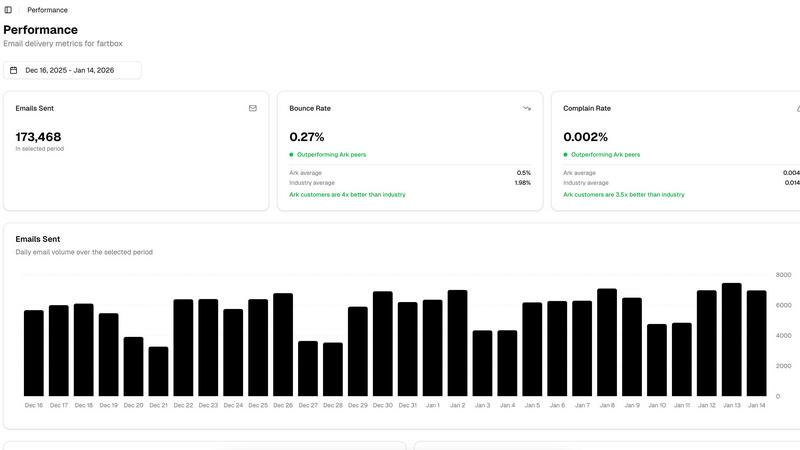
Visual Comparison
Ark
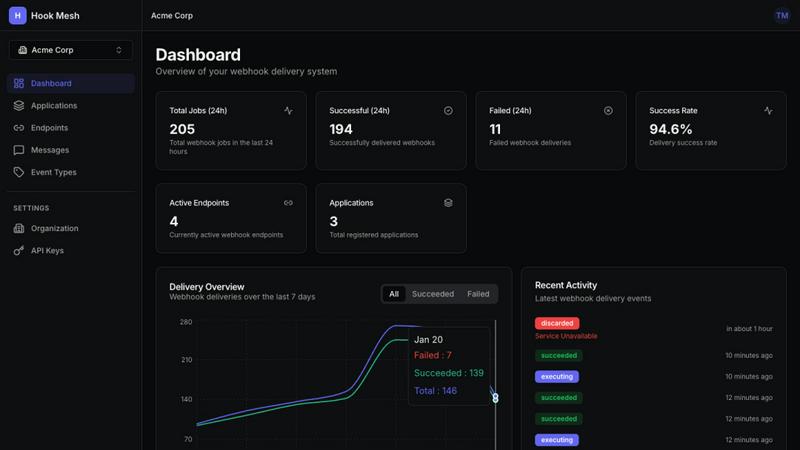
HookMesh
Feature Comparison
Ark
Native AI Agent Integration (MCP Server)
Ark comes with a built-in Model Context Protocol server featuring 26 dedicated tools, allowing AI coding assistants like Claude, Cursor, and Windsurf to send and manage emails directly through natural language prompts. This eliminates the need for boilerplate wrapper code and dramatically accelerates development workflows. The accompanying documentation is specifically optimized for AI readability, reducing token usage by up to 10x and making email functionality a natural extension of your AI-powered development process.
Built-In Multi-Tenant & White-Labeling
Every customer in your platform is fully isolated with their own domains, sending logs, and analytics dashboard. Ark is purpose-built for platforms, making it effortless to manage hundreds or thousands of customer domains from a single, unified interface. This white-label capability ensures your customers' emails come from their own branded domains (e.g., [email protected]), enhancing their professional image and making your platform an integral part of their business operations.
Automated Domain & DNS Management
Onboarding a new customer domain is a breeze. Ark automatically detects the customer's DNS provider (like Cloudflare, GoDaddy, or Route53) and provides them with exact, step-by-step instructions for configuration. For some providers, it can even auto-configure the necessary SPF, DKIM, and DMARC records. This self-service flow eliminates support tickets and Zoom calls explaining TXT records, getting new domains ready to send in minutes.
Real-Time Analytics & Webhooks
Gain complete visibility into your email ecosystem with real-time, per-customer analytics and webhooks. Track delivery rates, opens, clicks, and bounces for each tenant individually. This granular data allows you to instantly debug issues—like a single customer reporting missing emails—without sifting through a monolithic log file. Proactive monitoring and actionable insights are built directly into the dashboard.
HookMesh
Reliable Delivery Infrastructure
HookMesh provides a production-ready system that guarantees your webhooks get delivered. It features automatic retries with intelligent exponential backoff and jitter to prevent overwhelming endpoints, persistent retry logic that works for up to 48 hours, and smart circuit breakers that automatically pause delivery to consistently failing endpoints to protect your system's health. Every webhook is sent with idempotency keys, ensuring at-least-once delivery so your customers never miss a critical event due to network glitches or temporary outages.
Embedded Customer Portal
Turn webhook management into a self-service feature for your customers with HookMesh's white-label portal. You can seamlessly embed this UI directly into your own application or link to a hosted version. From this portal, your customers can securely add, verify, and manage their webhook endpoints. This eliminates back-and-forth support tickets for endpoint updates and empowers your users, providing a professional, integrated experience that enhances your product's value.
Full Visibility & Debugging Tools
End the mystery of failed webhook deliveries. HookMesh provides complete, detailed logs for every delivery attempt. Your team and your customers can see the exact request payload sent, the HTTP status code, headers, and the full response body from the destination endpoint. This unparalleled visibility turns hours of log digging into seconds of clarity. Combined with one-click replay for failed webhooks, it dramatically reduces mean time to resolution (MTTR) for any delivery issues.
Developer-First SDKs & API
Ship webhooks faster than ever with HookMesh's streamlined developer experience. Get started instantly with official, fully-supported SDKs for the most popular languages: JavaScript/Node.js, Python, and Go. The simple, intuitive REST API gives you programmatic control over every aspect. Before going live, use the interactive playground to test event payloads, signatures, and endpoint configurations, ensuring everything works perfectly before you flip the switch in production.
Use Cases
Ark
Multi-Tenant SaaS Platforms (CRMs, Helpdesks)
Platforms like CRMs and helpdesk software need to send notifications, alerts, and updates from each of their customer's own domains. Ark provides the isolated, white-label email infrastructure required for this, ensuring every client's communications are branded and authenticated properly without the platform developer having to build complex domain management systems from scratch.
Invoicing & Financial Applications
Invoicing tools require high-trust, domain-authenticated emails to ensure payment reminders and receipts reach the inbox and maintain professionalism. Ark enables these applications to send from customer domains like [email protected], directly increasing deliverability and trust for critical financial communications, all managed through a simple API.
AI-Powered Development & Automation Workflows
Development teams using AI agents (Claude Code, Cursor) or automation platforms (n8n, Vercel Serverless, Supabase Edge Functions) can integrate email sending as a native action. With Ark's MCP server and SDKs, sending an email becomes a natural language command or a simple function call within an existing workflow, supercharging productivity for AI-first developers.
Self-Hosted Tool Notification Systems
Tools like Listmonk (newsletters), Coolify (deployment), or Metabase (analytics) that are self-hosted often need a reliable SMTP relay for notifications. Ark's full SMTP relay support allows these tools to send high-deliverability emails without relying on consumer email services, providing enterprise-grade reliability and detailed logs for self-hosted environments.
HookMesh
SaaS Platform Notifications
Modern SaaS platforms need to notify customer systems about events like new user sign-ups, subscription changes, or data export completions. HookMesh allows these platforms to offer robust webhooks as a core feature without building the complex delivery infrastructure. Customers can connect their own internal systems reliably, and the platform team avoids the operational nightmare of managing retry queues and debugging external endpoint failures.
E-commerce & Payment Processing
E-commerce engines and payment processors depend on reliable webhooks to notify merchant systems about order confirmations, payment successes, failures, and refunds. With HookMesh, these critical financial events are guaranteed to be delivered. The self-service portal lets merchants manage their notification endpoints directly, while the circuit breaker prevents a single slow merchant backend from affecting the delivery queue for all other notifications.
DevOps & CI/CD Tools
Tools in the DevOps space use webhooks to trigger actions in other systems—like updating a deployment status in Slack or kicking off a pipeline in another CI tool upon a code commit. HookMesh ensures these automation triggers are never missed. Development teams can use the detailed logs to debug why a pipeline wasn't triggered, and the replay function allows them to resend the webhook instantly without requiring a new code event.
Customer Communication Platforms
Email service providers, SMS platforms, and marketing automation tools use webhooks to send real-time event data (e.g., email opened, message delivered, campaign clicked) back to their users' CRMs or data warehouses. HookMesh handles the high volume and variable reliability of customer endpoints, ensuring data continuity. Their users get full visibility into the event stream, making the integration transparent and trustworthy.
Pricing Comparison
Ark
Ark offers simple, predictable pricing designed to scale with your platform. Start with a $29 per month plan that includes 10 domains and 50,000 emails. Scale seamlessly to plans supporting 1,000 domains as your customer base grows. All plans include unlimited team members. For high-volume sending, pay-as-you-go pricing is available at just $0.50 per 1,000 emails. There are no complex tiers or hidden enterprise sales calls. New users can start a free trial with $5 in credits to test the platform.
HookMesh
HookMesh offers simple, predictable pricing based on the number of webhook messages delivered per month. All plans include automatic retries, the customer portal, and all core features without per-endpoint fees.
Free Tier: $0/month for 5,000 messages, includes all core features with community support and 7-day log retention. No credit card is required to start.
Starter Plan: $39/month for 50,000 messages, adding email support and 30-day log retention.
Growth Plan: $99/month for 250,000 messages, adding priority support and 60-day log retention. This is the most popular plan for growing teams.
Business Plan: $249/month for 1,000,000 messages, featuring dedicated support and 90-day log retention for mission-critical use cases.
Overview
About Ark
Ark is the revolutionary email API built from the ground up for AI-first developers and multi-tenant software platforms. Forget wrestling with single-sender email services that crumble under the weight of your customers' needs. Ark is the white-label email infrastructure that lets you embed professional, domain-authenticated email sending directly into your CRM, helpdesk, invoicing, or scheduling application. Its native MCP server with 26 tools allows AI agents like Claude, Cursor, and Windsurf to send emails through natural language, eliminating wrapper code and slashing token usage with AI-optimized documentation. Designed for platforms that send on behalf of their users, Ark provides built-in tenant isolation, per-customer domain management, and detailed analytics, so you can stop building email infrastructure and get back to your core product. With sub-second delivery, 99.9% deliverability, automatic email authentication, and a transparent pricing model, Ark empowers developers to ship faster, automate smarter, and scale seamlessly without the enterprise sales calls.
About HookMesh
HookMesh is the battle-tested infrastructure that makes webhooks a superpower for your product, not a burden. It's the complete solution for SaaS companies and developers who need to send real-time notifications to their customers but want to skip the months of engineering work required to build a reliable system in-house. HookMesh handles the entire complex lifecycle of webhook delivery—automatic retries with exponential backoff, circuit breakers, idempotency, and queue management—so your team never has to wrestle with tricky logic or debug "where's my webhook?" support tickets again. Beyond the backend, HookMesh provides a powerful, embeddable customer portal that gives your users self-service control. They can add endpoints, inspect detailed delivery logs with full request/response visibility, and replay failed webhooks with one click. With official SDKs for JavaScript, Python, and Go, you can integrate in minutes and start shipping reliable webhooks today, backed by a generous free tier. HookMesh delivers peace of mind for you and a premium experience for your customers.
Frequently Asked Questions
Ark FAQ
How is Ark different from Resend or SendGrid?
Ark is fundamentally built for multi-tenant platforms, while services like Resend, SendGrid, and Postmark are designed for a single company to send from its own domains. Ark provides built-in tenant isolation, per-customer domain management, white-labeling, and individual analytics dashboards. Trying to achieve this with other services requires building a complex layer of custom logic on top of their API.
How does the domain onboarding process work?
When a customer adds their domain in your platform, Ark identifies their DNS provider and generates customized, simple instructions for them to add the necessary verification and authentication records (SPF, DKIM). For supported providers like Cloudflare, the configuration can be automatic. This self-service process typically takes customers just a few minutes without requiring your support team's intervention.
Can I use Ark with my existing codebase and infrastructure?
Absolutely. Ark offers full-featured SDKs for Python, Node.js, Ruby, and Go, and integrates seamlessly into any stack. It works perfectly with serverless functions (Vercel, Supabase), automation tools (n8n), and provides a standard SMTP relay for legacy or self-hosted tools. You can plug it into your existing workflows with minimal code changes.
What does "99.9% deliverability" mean?
This means that 99.9% of emails sent through Ark's infrastructure successfully reach the recipient's mail server inbox, not the spam folder. This is achieved through rigorous infrastructure management, automatic configuration of sender authentication protocols (SPF, DKIM, DMARC), and maintained relationships with internet service providers, ensuring your customers' important emails are reliably delivered.
HookMesh FAQ
How does HookMesh ensure webhooks aren't lost?
HookMesh guarantees at-least-once delivery using a combination of durable persistence, automatic retries with exponential backoff for up to 48 hours, and idempotency keys. When you send a webhook to us, we immediately acknowledge and store it. Our system then takes full responsibility for delivery, retrying through transient failures. The idempotency key ensures that even if a retry is sent, the receiving system can recognize and handle it as the same event.
Can I customize the customer portal to match my app's branding?
Yes! The HookMesh customer portal is designed to be embedded and can be styled to fit seamlessly within your application's user interface. You control the integration, allowing for a native, white-labeled experience. This means your customers manage their webhooks without ever leaving your product's environment, maintaining your brand's look and feel throughout the entire user journey.
What happens when a customer's endpoint is down for a long time?
HookMesh's circuit breaker feature automatically detects endpoints that are consistently failing or timing out. After a configured number of failures, it will "trip" and pause delivery to that specific endpoint. This prevents your queue from backing up and protects system resources. The circuit will periodically attempt to send a test webhook to see if the endpoint has recovered, and will automatically resume normal delivery once it's back online.
Is there a way to test webhooks before sending them to live endpoints?
Absolutely. HookMesh includes a built-in Playground that allows you to simulate webhook events. You can craft payloads, test against your endpoint URLs (including using tools like webhook.site), and verify signatures without affecting your live configuration. This is an essential tool for development, testing new event types, and ensuring your customer's integration logic works correctly before enabling it in production.
Alternatives
Ark Alternatives
Ark is an AI-ready email API built for developers who build and automate with AI. It's a developer tool that simplifies sending emails through natural language commands within AI agents like Claude and Cursor, eliminating the need for complex wrapper code. Developers might look for alternatives for various reasons. Perhaps they need a different pricing model, require specific features like advanced marketing automation, or must integrate with a legacy on-premise system. Others may prioritize a different developer experience or have unique compliance requirements. When evaluating options, consider core needs: seamless integration with your existing stack (like serverless functions or workflows), robust deliverability and security features, clear and cost-effective pricing, and the quality of the developer experience, including documentation and SDK support.
HookMesh Alternatives
HookMesh is a developer tool that takes the pain out of building and managing webhook infrastructure. It's a specialized service that handles the complex logic of reliable delivery, so your team can focus on your core product instead of debugging failed webhooks. Developers often explore alternatives for various reasons. You might be looking for a different pricing model, need a specific integration not yet offered, or require a solution that's part of a larger platform suite. It's smart to evaluate the landscape to find the perfect fit for your stack and budget. When comparing options, focus on the essentials for production reliability. Look for robust retry mechanisms with exponential backoff, clear visibility into delivery logs, and tools that empower your end-users. The goal is to find a solution that makes webhooks a seamless feature, not a constant source of support tickets.