
HookMesh vs Playwriter

Last updated: February 28, 2026

Last updated: March 18, 2026
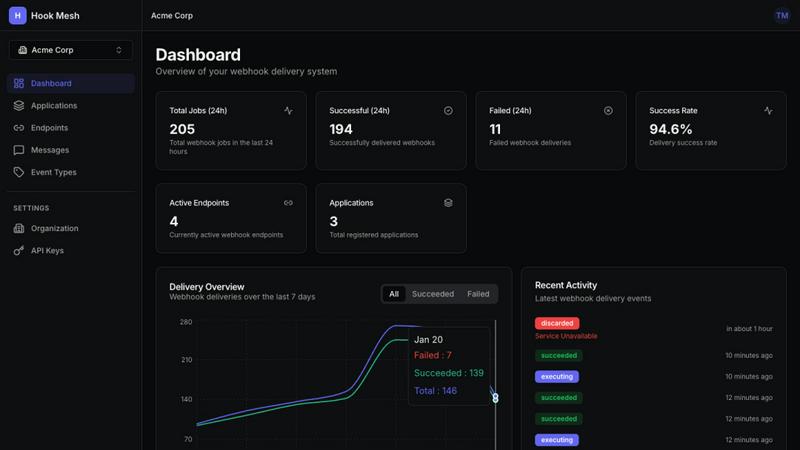
Visual Comparison
HookMesh
Playwriter

Feature Comparison
HookMesh
Reliable Delivery Infrastructure
HookMesh provides a production-ready system that guarantees your webhooks get delivered. It features automatic retries with intelligent exponential backoff and jitter to prevent overwhelming endpoints, persistent retry logic that works for up to 48 hours, and smart circuit breakers that automatically pause delivery to consistently failing endpoints to protect your system's health. Every webhook is sent with idempotency keys, ensuring at-least-once delivery so your customers never miss a critical event due to network glitches or temporary outages.
Embedded Customer Portal
Turn webhook management into a self-service feature for your customers with HookMesh's white-label portal. You can seamlessly embed this UI directly into your own application or link to a hosted version. From this portal, your customers can securely add, verify, and manage their webhook endpoints. This eliminates back-and-forth support tickets for endpoint updates and empowers your users, providing a professional, integrated experience that enhances your product's value.
Full Visibility & Debugging Tools
End the mystery of failed webhook deliveries. HookMesh provides complete, detailed logs for every delivery attempt. Your team and your customers can see the exact request payload sent, the HTTP status code, headers, and the full response body from the destination endpoint. This unparalleled visibility turns hours of log digging into seconds of clarity. Combined with one-click replay for failed webhooks, it dramatically reduces mean time to resolution (MTTR) for any delivery issues.
Developer-First SDKs & API
Ship webhooks faster than ever with HookMesh's streamlined developer experience. Get started instantly with official, fully-supported SDKs for the most popular languages: JavaScript/Node.js, Python, and Go. The simple, intuitive REST API gives you programmatic control over every aspect. Before going live, use the interactive playground to test event payloads, signatures, and endpoint configurations, ensuring everything works perfectly before you flip the switch in production.
Playwriter
Your Real Browser Session
Playwriter doesn't spawn a new, sterile browser. It attaches directly to your existing Chrome tabs via a debugger connection. This means every website you're already logged into—Gmail, GitHub, admin dashboards—is instantly available to your AI agent. Your extensions (like password managers or ad blockers) are active, and your cookies are present, completely bypassing the bot detection that plagues fresh, headless instances. It's browsing with your identity, without the overhead.
Full Playwright API Through a Single Tool
Instead of limiting agents to a fixed set of pre-defined tools (like "click" or "type"), Playwriter exposes one powerful execute tool. Your agent can run any valid Playwright code, unlocking the entire automation library: complex selectors, network interception, performance profiling, and setting breakpoints. This keeps the AI's context window lean by avoiding schema bloat from dozens of tool definitions and grants unparalleled flexibility.
Advanced Debugging & Collaboration Suite
Playwriter is built for real-world debugging and human-AI teamwork. It includes a live debugger with breakpoints, live code editing, and network request interception. You can watch the agent work in real-time on your screen. When it hits a CAPTCHA or a consent wall, you simply solve it and let the agent continue. If it gets stuck, you can temporarily disable control, fix the page manually, and re-enable it—seamless collaboration.
Lightweight Accessibility Snapshots & Recording
Forget massive, context-consuming screenshots. Playwriter generates compact accessibility snapshots (only 5-20KB) that provide the AI with a structured, semantic view of the page. It also includes visual labeling for elements and can record full video of the agent's session. Combined with network interception, this gives your AI deep, efficient insight into page state and behavior.
Use Cases
HookMesh
SaaS Platform Notifications
Modern SaaS platforms need to notify customer systems about events like new user sign-ups, subscription changes, or data export completions. HookMesh allows these platforms to offer robust webhooks as a core feature without building the complex delivery infrastructure. Customers can connect their own internal systems reliably, and the platform team avoids the operational nightmare of managing retry queues and debugging external endpoint failures.
E-commerce & Payment Processing
E-commerce engines and payment processors depend on reliable webhooks to notify merchant systems about order confirmations, payment successes, failures, and refunds. With HookMesh, these critical financial events are guaranteed to be delivered. The self-service portal lets merchants manage their notification endpoints directly, while the circuit breaker prevents a single slow merchant backend from affecting the delivery queue for all other notifications.
DevOps & CI/CD Tools
Tools in the DevOps space use webhooks to trigger actions in other systems—like updating a deployment status in Slack or kicking off a pipeline in another CI tool upon a code commit. HookMesh ensures these automation triggers are never missed. Development teams can use the detailed logs to debug why a pipeline wasn't triggered, and the replay function allows them to resend the webhook instantly without requiring a new code event.
Customer Communication Platforms
Email service providers, SMS platforms, and marketing automation tools use webhooks to send real-time event data (e.g., email opened, message delivered, campaign clicked) back to their users' CRMs or data warehouses. HookMesh handles the high volume and variable reliability of customer endpoints, ensuring data continuity. Their users get full visibility into the event stream, making the integration transparent and trustworthy.
Playwriter
Automated Web Testing & Debugging
Developers can instruct their AI assistant to run complex, multi-step user flows on their already-logged-in development or staging environments. The agent can click through UIs, fill forms, intercept API calls to verify payloads, and profile performance—all within the exact browser context a real user would have, making tests more reliable and context-aware.
AI-Powered Research & Data Extraction
Researchers and analysts can task an AI with gathering information from websites that require login or have complex interactive elements. Since Playwriter uses the real browser, it can navigate paywalls, logged-in databases, and JavaScript-heavy dashboards that are completely inaccessible to traditional, headless agent tools.
Routine Task Automation
Automate repetitive daily web tasks without writing a single line of code yourself. Have your AI agent log in to platforms, generate reports, schedule posts, or monitor status pages. Because it works in your browser session, it can handle two-factor authentication flows where you approve the login prompt.
Enhanced AI Assistant Capabilities
Supercharge coding assistants like Cursor or Claude. Instead of just writing hypothetical code, your AI can now execute Playwright scripts to interact with live documentation, pull examples from a web API, test a component in Storybook, or even debug a live web application by manipulating the DOM and inspecting network traffic in real-time.
Overview
About HookMesh
HookMesh is the battle-tested infrastructure that makes webhooks a superpower for your product, not a burden. It's the complete solution for SaaS companies and developers who need to send real-time notifications to their customers but want to skip the months of engineering work required to build a reliable system in-house. HookMesh handles the entire complex lifecycle of webhook delivery—automatic retries with exponential backoff, circuit breakers, idempotency, and queue management—so your team never has to wrestle with tricky logic or debug "where's my webhook?" support tickets again. Beyond the backend, HookMesh provides a powerful, embeddable customer portal that gives your users self-service control. They can add endpoints, inspect detailed delivery logs with full request/response visibility, and replay failed webhooks with one click. With official SDKs for JavaScript, Python, and Go, you can integrate in minutes and start shipping reliable webhooks today, backed by a generous free tier. HookMesh delivers peace of mind for you and a premium experience for your customers.
About Playwriter
Stop fighting with headless browsers and bot detection. Playwriter is the game-changing bridge that lets your AI agents operate directly within your real, logged-in Chrome browser. It's a Chrome extension and CLI that gives any MCP client (like Cursor, Claude Desktop, or VS Code) the full power of the Playwright automation API, but executed in your existing browser session. This means your agents have immediate access to all your extensions, cookies, and logins—no fresh Chrome instance, no extra memory load, and no instant red flags from websites. It turns the brittle, limited browsing of today's AI into a seamless, powerful, and collaborative experience. Built for developers, researchers, and power users who need their AI assistants to interact with the modern web as a human would, Playwriter is open-source (MIT licensed) and runs entirely locally on your machine, putting you in full control.
Frequently Asked Questions
HookMesh FAQ
How does HookMesh ensure webhooks aren't lost?
HookMesh guarantees at-least-once delivery using a combination of durable persistence, automatic retries with exponential backoff for up to 48 hours, and idempotency keys. When you send a webhook to us, we immediately acknowledge and store it. Our system then takes full responsibility for delivery, retrying through transient failures. The idempotency key ensures that even if a retry is sent, the receiving system can recognize and handle it as the same event.
Can I customize the customer portal to match my app's branding?
Yes! The HookMesh customer portal is designed to be embedded and can be styled to fit seamlessly within your application's user interface. You control the integration, allowing for a native, white-labeled experience. This means your customers manage their webhooks without ever leaving your product's environment, maintaining your brand's look and feel throughout the entire user journey.
What happens when a customer's endpoint is down for a long time?
HookMesh's circuit breaker feature automatically detects endpoints that are consistently failing or timing out. After a configured number of failures, it will "trip" and pause delivery to that specific endpoint. This prevents your queue from backing up and protects system resources. The circuit will periodically attempt to send a test webhook to see if the endpoint has recovered, and will automatically resume normal delivery once it's back online.
Is there a way to test webhooks before sending them to live endpoints?
Absolutely. HookMesh includes a built-in Playground that allows you to simulate webhook events. You can craft payloads, test against your endpoint URLs (including using tools like webhook.site), and verify signatures without affecting your live configuration. This is an essential tool for development, testing new event types, and ensuring your customer's integration logic works correctly before enabling it in production.
Playwriter FAQ
Is my browsing data sent to a remote server?
No. Playwriter is designed with privacy and security first. All communication happens via a WebSocket relay running on localhost:19988 on your own machine. The Chrome extension, CLI, and your AI client communicate directly with this local relay. No browsing data, credentials, or session cookies are ever transmitted to any remote server.
How does Playwriter avoid bot detection?
It avoids detection by not acting like a typical bot. It controls your genuine, user-initiated Chrome browser session, which already has a normal history, cookies, and likely some browser extensions installed. This fingerprint matches that of a regular human user, unlike a fresh, headless Chrome instance which lacks these signals and is easily flagged.
Can I use it with any AI or just specific MCP clients?
Playwriter works with any client that supports the Model Context Protocol (MCP), which is becoming a standard for AI tool integration. This includes popular environments like Cursor, Claude Desktop, VS Code with extensions, and more. The provided skill teaches these clients how to use Playwriter effectively.
What happens if the AI gets stuck or makes a mistake?
This is where the collaboration features shine. You watch the actions happen live in your browser. If the agent enters an error state or gets stuck in a loop, you can immediately click the extension icon to detach it from that tab (turning it gray), manually correct the situation, and then re-attach control. The agent can then continue from the corrected state.
Alternatives
HookMesh Alternatives
HookMesh is a developer tool that takes the pain out of building and managing webhook infrastructure. It's a specialized service that handles the complex logic of reliable delivery, so your team can focus on your core product instead of debugging failed webhooks. Developers often explore alternatives for various reasons. You might be looking for a different pricing model, need a specific integration not yet offered, or require a solution that's part of a larger platform suite. It's smart to evaluate the landscape to find the perfect fit for your stack and budget. When comparing options, focus on the essentials for production reliability. Look for robust retry mechanisms with exponential backoff, clear visibility into delivery logs, and tools that empower your end-users. The goal is to find a solution that makes webhooks a seamless feature, not a constant source of support tickets.
Playwriter Alternatives
Playwriter is a developer tool that bridges AI agents directly to your real browser session. It solves the core problem of AI automation by providing access to your actual logged-in state, extensions, and settings, instead of a fresh, empty browser that gets instantly flagged. Developers often look for alternatives for various reasons. They might need different pricing models, require specific integrations with other tools in their stack, or be looking for a particular feature set that matches their unique workflow. The landscape of browser automation and AI agent tools is constantly evolving. When evaluating options, consider the core capability of session persistence, the depth of debugging and control features, compatibility with your preferred AI clients and IDEs, and the overall philosophy of the project regarding openness, security, and extensibility. The right tool should feel like a natural extension of your development process.