
HookMesh vs Requestly

Last updated: February 28, 2026

Last updated: March 26, 2026
Visual Comparison
HookMesh
Requestly
Feature Comparison
HookMesh
Reliable Delivery Infrastructure
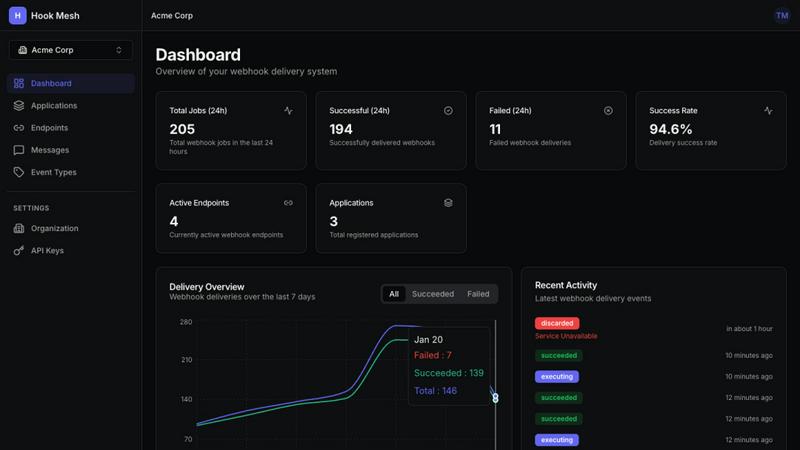
HookMesh provides a production-ready system that guarantees your webhooks get delivered. It features automatic retries with intelligent exponential backoff and jitter to prevent overwhelming endpoints, persistent retry logic that works for up to 48 hours, and smart circuit breakers that automatically pause delivery to consistently failing endpoints to protect your system's health. Every webhook is sent with idempotency keys, ensuring at-least-once delivery so your customers never miss a critical event due to network glitches or temporary outages.
Embedded Customer Portal
Turn webhook management into a self-service feature for your customers with HookMesh's white-label portal. You can seamlessly embed this UI directly into your own application or link to a hosted version. From this portal, your customers can securely add, verify, and manage their webhook endpoints. This eliminates back-and-forth support tickets for endpoint updates and empowers your users, providing a professional, integrated experience that enhances your product's value.
Full Visibility & Debugging Tools
End the mystery of failed webhook deliveries. HookMesh provides complete, detailed logs for every delivery attempt. Your team and your customers can see the exact request payload sent, the HTTP status code, headers, and the full response body from the destination endpoint. This unparalleled visibility turns hours of log digging into seconds of clarity. Combined with one-click replay for failed webhooks, it dramatically reduces mean time to resolution (MTTR) for any delivery issues.
Developer-First SDKs & API
Ship webhooks faster than ever with HookMesh's streamlined developer experience. Get started instantly with official, fully-supported SDKs for the most popular languages: JavaScript/Node.js, Python, and Go. The simple, intuitive REST API gives you programmatic control over every aspect. Before going live, use the interactive playground to test event payloads, signatures, and endpoint configurations, ensuring everything works perfectly before you flip the switch in production.
Requestly
Git-Native Collections
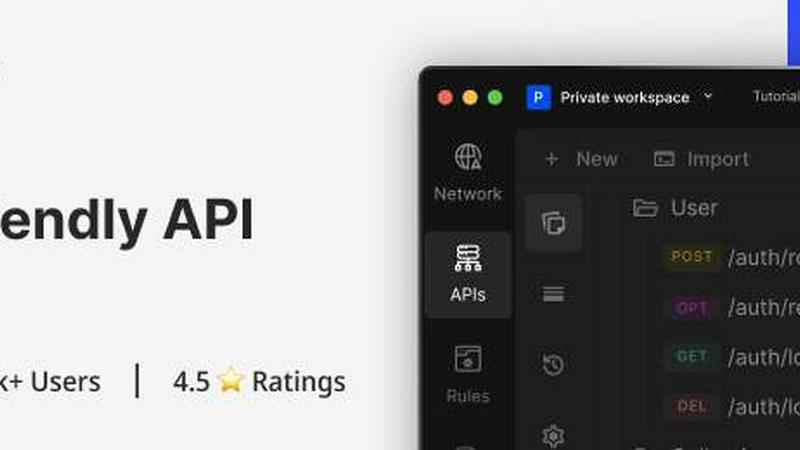
Requestly allows you to store your API collections as local files that can easily be managed through Git. This feature enables you to version control your API workflows, branch out for new features, and collaborate seamlessly with your team, just like you would with your source code.
AI-Enhanced Request Writing
Leverage the power of AI to streamline your API development. Requestly's built-in intelligence assists developers in crafting requests, generating tests, and debugging APIs more efficiently, allowing for a smoother development experience and less time spent on manual tasks.
Multi-Workspace Management
Easily manage multiple local workspaces simultaneously with Requestly's multi-workspace view. This feature enhances productivity by allowing developers to switch contexts quickly and organize their API projects without the hassle of cloud storage.
Comprehensive Authorization Management
Requestly provides a centralized interface for managing authorization details, enabling you to organize them at both the collection and request levels. This makes it easy to handle various authentication methods, ensuring secure access to your APIs without complications.
Use Cases
HookMesh
SaaS Platform Notifications
Modern SaaS platforms need to notify customer systems about events like new user sign-ups, subscription changes, or data export completions. HookMesh allows these platforms to offer robust webhooks as a core feature without building the complex delivery infrastructure. Customers can connect their own internal systems reliably, and the platform team avoids the operational nightmare of managing retry queues and debugging external endpoint failures.
E-commerce & Payment Processing
E-commerce engines and payment processors depend on reliable webhooks to notify merchant systems about order confirmations, payment successes, failures, and refunds. With HookMesh, these critical financial events are guaranteed to be delivered. The self-service portal lets merchants manage their notification endpoints directly, while the circuit breaker prevents a single slow merchant backend from affecting the delivery queue for all other notifications.
DevOps & CI/CD Tools
Tools in the DevOps space use webhooks to trigger actions in other systems—like updating a deployment status in Slack or kicking off a pipeline in another CI tool upon a code commit. HookMesh ensures these automation triggers are never missed. Development teams can use the detailed logs to debug why a pipeline wasn't triggered, and the replay function allows them to resend the webhook instantly without requiring a new code event.
Customer Communication Platforms
Email service providers, SMS platforms, and marketing automation tools use webhooks to send real-time event data (e.g., email opened, message delivered, campaign clicked) back to their users' CRMs or data warehouses. HookMesh handles the high volume and variable reliability of customer endpoints, ensuring data continuity. Their users get full visibility into the event stream, making the integration transparent and trustworthy.
Requestly
Quick API Testing
With Requestly, developers can swiftly test APIs without the overhead of complex setups. The intuitive interface allows for rapid request creation and testing, making it ideal for developers who need immediate results during the development cycle.
Team Collaboration on API Projects
Requestly's shared workspace feature enables teams to collaborate on API projects effortlessly. Team members can work together in real-time, share collections, and manage changes, enhancing productivity and ensuring everyone is on the same page.
Migration from Postman
For teams transitioning from Postman, Requestly offers a one-click import feature that allows users to migrate their collections and environments seamlessly. This makes switching to Requestly easy and hassle-free, ensuring no loss of productivity during the transition.
API Documentation and Debugging
Utilize Requestly to maintain comprehensive documentation of your APIs while also debugging them effectively. The built-in logging features keep track of API calls, allowing developers to review and resolve issues quickly, which enhances overall API reliability.
Overview
About HookMesh
HookMesh is the battle-tested infrastructure that makes webhooks a superpower for your product, not a burden. It's the complete solution for SaaS companies and developers who need to send real-time notifications to their customers but want to skip the months of engineering work required to build a reliable system in-house. HookMesh handles the entire complex lifecycle of webhook delivery—automatic retries with exponential backoff, circuit breakers, idempotency, and queue management—so your team never has to wrestle with tricky logic or debug "where's my webhook?" support tickets again. Beyond the backend, HookMesh provides a powerful, embeddable customer portal that gives your users self-service control. They can add endpoints, inspect detailed delivery logs with full request/response visibility, and replay failed webhooks with one click. With official SDKs for JavaScript, Python, and Go, you can integrate in minutes and start shipping reliable webhooks today, backed by a generous free tier. HookMesh delivers peace of mind for you and a premium experience for your customers.
About Requestly
Requestly is a cutting-edge API client tailored for modern development teams seeking enhanced control over their API workflows. Unlike traditional tools like Postman, Requestly is a lightweight, local-first solution that prioritizes data privacy by keeping all information securely on your machine. This innovative approach allows teams to manage their API collections using git, enabling version control, branching, and collaborative efforts akin to software development practices. With an AI-native framework, Requestly accelerates the process of writing requests, generating tests, and debugging APIs, making it a must-have for developers. It supports both REST and GraphQL protocols, offering features like schema introspection and environment variables. Furthermore, Requestly stands out with its generous free-tier offerings, including shared workspaces, role-based access, and seamless Postman migration—all without requiring any login to get started. Trusted by over 300,000 developers from leading companies like Microsoft, Amazon, Google, and Adobe, Requestly is revolutionizing the way developers interact with APIs.
Frequently Asked Questions
HookMesh FAQ
How does HookMesh ensure webhooks aren't lost?
HookMesh guarantees at-least-once delivery using a combination of durable persistence, automatic retries with exponential backoff for up to 48 hours, and idempotency keys. When you send a webhook to us, we immediately acknowledge and store it. Our system then takes full responsibility for delivery, retrying through transient failures. The idempotency key ensures that even if a retry is sent, the receiving system can recognize and handle it as the same event.
Can I customize the customer portal to match my app's branding?
Yes! The HookMesh customer portal is designed to be embedded and can be styled to fit seamlessly within your application's user interface. You control the integration, allowing for a native, white-labeled experience. This means your customers manage their webhooks without ever leaving your product's environment, maintaining your brand's look and feel throughout the entire user journey.
What happens when a customer's endpoint is down for a long time?
HookMesh's circuit breaker feature automatically detects endpoints that are consistently failing or timing out. After a configured number of failures, it will "trip" and pause delivery to that specific endpoint. This prevents your queue from backing up and protects system resources. The circuit will periodically attempt to send a test webhook to see if the endpoint has recovered, and will automatically resume normal delivery once it's back online.
Is there a way to test webhooks before sending them to live endpoints?
Absolutely. HookMesh includes a built-in Playground that allows you to simulate webhook events. You can craft payloads, test against your endpoint URLs (including using tools like webhook.site), and verify signatures without affecting your live configuration. This is an essential tool for development, testing new event types, and ensuring your customer's integration logic works correctly before enabling it in production.
Requestly FAQ
What is Requestly and how does it differ from Postman?
Requestly is a lightweight API client designed for modern developers, offering a local-first approach that stores data on your machine. Unlike Postman, it emphasizes collaboration through git-based collections and does not require a login to start using it.
Can I use Requestly for GraphQL APIs?
Yes, Requestly supports GraphQL APIs, providing features like schema introspection and auto-completion, making it easier for developers to work with GraphQL endpoints efficiently.
How does Requestly ensure data privacy?
Requestly prioritizes data privacy by keeping all API data stored locally on your machine rather than in the cloud, ensuring that your sensitive information remains secure and under your control.
Is there a free version of Requestly available?
Absolutely! Requestly offers a generous free tier that includes team collaboration features, shared workspaces, and the ability to import from Postman, making it accessible for developers without any upfront costs.
Alternatives
HookMesh Alternatives
HookMesh is a developer tool that takes the pain out of building and managing webhook infrastructure. It's a specialized service that handles the complex logic of reliable delivery, so your team can focus on your core product instead of debugging failed webhooks. Developers often explore alternatives for various reasons. You might be looking for a different pricing model, need a specific integration not yet offered, or require a solution that's part of a larger platform suite. It's smart to evaluate the landscape to find the perfect fit for your stack and budget. When comparing options, focus on the essentials for production reliability. Look for robust retry mechanisms with exponential backoff, clear visibility into delivery logs, and tools that empower your end-users. The goal is to find a solution that makes webhooks a seamless feature, not a constant source of support tickets.
Requestly Alternatives
Requestly is a local-first, git-driven API client that empowers modern development teams by providing them with complete control over their API workflows. Unlike traditional cloud-based solutions, Requestly stores data locally, allowing users to manage API collections as files that can be versioned, branched, and collaborated on through git, just like code. This innovative tool is designed to enhance productivity for developers by offering features tailored to streamline the API development process. Users often seek alternatives to tools like Requestly for various reasons, including pricing structures, specific feature sets, or compatibility with their preferred platforms. When exploring alternatives, it is essential to consider factors such as ease of use, collaboration capabilities, support for different API types, and the overall flexibility of the tool. A good alternative should not only meet current needs but also scale as your development processes evolve.