
SoloPass vs Vidgo API

SoloPass
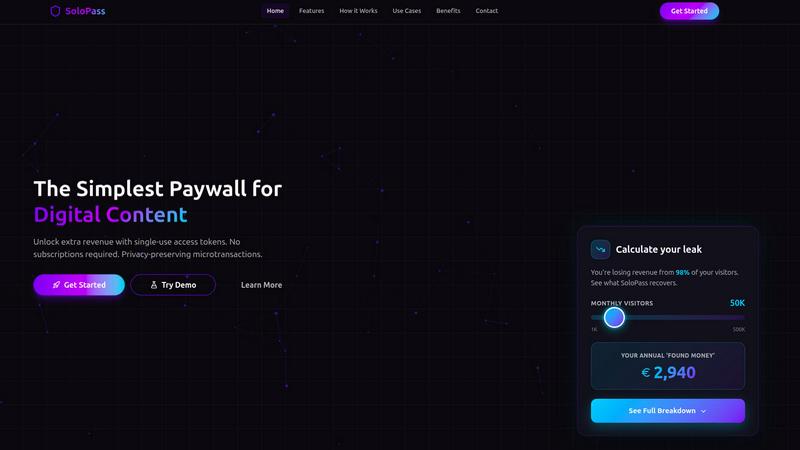
The Simplest Paywall for Digital Content

Visual Comparison
SoloPass
Vidgo API

Overview
About SoloPass
SoloPass is a privacy-first micropayment platform designed to help digital creators and publishers monetize individual pieces of content without requiring monthly subscriptions. The service allows users to purchase single-use access tokens for articles, videos, or downloads through a seamless, one-click payment process. A standout feature is its commitment to privacy, offering users the option to create anonymous 16-digit account numbers that require no personal data collection. Payments are handled via secure Open Banking APIs, which eliminates the friction of traditional credit card entry and reduces transaction fees. For publishers, the platform offers a "5-minute integration" that uses simple code snippets to protect content hosted on their own servers. It also includes AI-powered dynamic pricing that automatically adjusts costs based on demand to maximize revenue potential. Creators benefit from a hands-off financial model where SoloPass manages all payment processing, disputes, and settlements on an invoice basis.
About Vidgo API
Vidgo API is a unified AI media generation platform offering world-leading models for video, image, and music creation through a single REST API.
Video Generation (12+ Models): Kling 2.6 Motion Control, Seedance 1.5 Pro (#1 global), Hailuo 02, Wan 2.6, Sora 2 Pro, Veo 3.1, Grok Imagine. Supports text-to-video, image-to-video, motion control, and character animation up to 1080p with synchronized audio.
Image Generation (9+ Models): GPT Image 1.5, Nano Banana Pro (4K), Seedream 4.5, FLUX.2, Z-Image. Enables text-to-image, editing, and multi-reference composition with professional text rendering.
Music Generation (15+ Endpoints): Complete production suite including Suno Music generation, track extension, vocal/instrumental layering, stem splitting, AI music videos, and lyric generation.
Key Advantages: 15-95% cheaper than competitors (Fal.ai). Pay-per-use credits.
Comprehensive documentation at docs.vidgo.ai.