
Interactive Circle of Fifths
Master music theory with our interactive Circle of Fifths for instant scales, chords, and progressions.
About Interactive Circle of Fifths
Unlock the secret language of music theory and supercharge your creativity with the Interactive Circle of Fifths! This isn't just a static diagram; it's a dynamic, hands-on music theory lab designed for musicians of all levels. Whether you're a songwriter battling writer's block, a beginner guitarist trying to understand chord progressions, or a seasoned pianist looking for fresh harmonic colors, this tool transforms abstract theory into an intuitive, visual, and auditory experience. Its core value is demystification: it makes complex relationships between keys, chords, and scales instantly understandable. See the connections, hear the harmonies, and apply the knowledge directly to your instrument. By integrating a fully interactive circle with real-time piano and guitar visualizers, it bridges the gap between theoretical knowledge and practical playability. Stop memorizing and start understanding. The Interactive Circle of Fifths is your all-in-one companion for composition, improvisation, practice, and deep musical exploration, turning the foundational wheel of harmony into your most powerful creative engine.
Features of Interactive Circle of Fifths
Dynamic Circle & Key Exploration
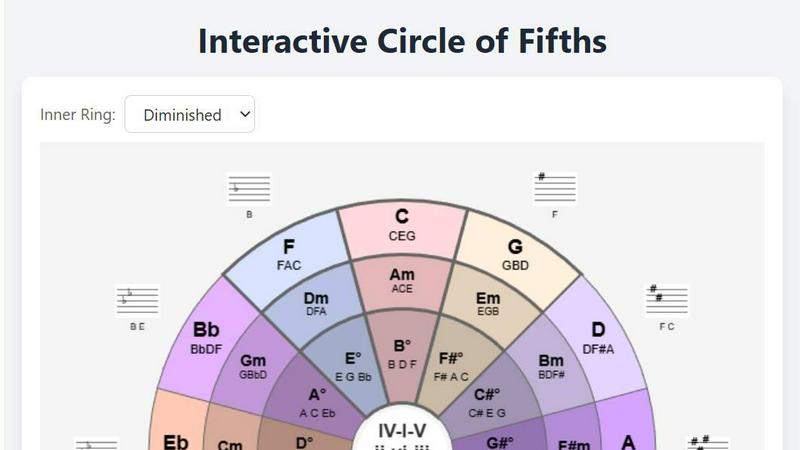
Click on any key around the circle to instantly reconfigure the entire tool. Watch as the inner rings, chord panels, and scale information update in real-time to reflect your chosen key. This allows for seamless exploration of all twelve major and minor keys, visually demonstrating their relationships and shared chords. It's the fastest way to understand modulation and the intrinsic structure of the Circle of Fifths itself, making key signatures and their connections crystal clear.
Multi-Instrument Visualizers (Piano & Guitar)
Go beyond theory and see exactly how to play. Integrated piano and guitar fingerboard visualizers light up to show you the precise notes and recommended fingerings for any selected chord or scale. This feature directly translates harmonic knowledge into muscle memory, helping beginners learn shapes and aiding advanced players in finding new voicings and positions across the neck or keyboard instantly.
Comprehensive Scale & Chord Library
Dive deep into harmonic building blocks with dedicated selectors for scales and chords. Instantly display and hear major, minor, and diminished chords. Explore essential scales like the Pentatonic, Blues, Diatonic, and Diminished scales directly from the inner ring. This library puts a universe of melodic and harmonic colors at your fingertips, encouraging experimentation and a deeper understanding of scale-chord relationships.
Harmonized Scale & Chord Sequencer Panel
This powerful panel displays all the diatonic chords (like C, Dm, Em, F, G, Am, B°) for your selected key, labeled with both their musical names and Roman numeral functions (I, ii, iii, etc.). Understand chord function, see what each chord "resolves to," and use this knowledge to build rock-solid or creatively unexpected progressions. It's the ultimate cheat sheet for songwriting and analyzing the music you love.
Use Cases of Interactive Circle of Fifths
Songwriting & Chord Progression Design
Break through creative blocks by using the Harmonized Scale panel and Chord Sequencer. Experiment with different diatonic chords (I, IV, V, vi) in any key, hear how they sound together, and discover smooth, functional progressions. The "Resolves To" function provides expert guidance on natural harmonic movement, helping you craft verses, choruses, and bridges that are both emotionally compelling and theoretically sound.
Instrument Learning & Practice
Ideal for students on piano or guitar. Use the visualizers to learn chord shapes and scale patterns in any key. A guitarist can practice the blues scale in A, while a pianist drills the diatonic chords in F# minor. It turns practice sessions into exploratory missions, reinforcing the connection between the notes on the screen, the sounds you hear, and the physical layout of your instrument.
Music Theory Education & Visualization
Teachers and self-learners can use the tool to visually demonstrate abstract concepts. Show how the circle is built, how relative minors work, or what makes a dominant seventh chord want to resolve. Watching the entire interface change with a single click makes theory tangible, accelerating comprehension far beyond textbook diagrams and rote memorization.
Improvisation & Solo Development
Select a backing chord from the sequencer and then explore compatible scales from the inner ring, like the Pentatonic or Blues scale. The visualizer shows you the "safe" notes to play over that chord across the entire fretboard or keyboard. This builds confidence and vocabulary for soloing, helping musicians move from playing memorized licks to creating meaningful, in-key melodic phrases on the fly.
Frequently Asked Questions
Do I need to know music theory to use this tool?
Not at all! The Interactive Circle of Fifths is designed to teach you theory through interaction. You can start by simply clicking on keys and chords to hear them and see the fingerings. The visual relationships on the circle and panels will intuitively guide your understanding, making it perfect for absolute beginners while still being a powerful reference for advanced users.
Which instruments does this support?
The tool provides dedicated visualizers for both piano (keyboard) and guitar (fretboard). When you select a chord or scale, the corresponding notes are highlighted on both instrument diagrams, giving you the exact fingering. The core theory concepts apply universally to all instruments, from bass to vocals.
Can I use this to help me write a song in a specific key?
Absolutely. First, select your desired key on the outer circle. Then, use the Harmonized Scale panel to see all the chords naturally available in that key. The Chord Sequencer lets you audition different progressions (like I-V-vi-IV) and hear how they sound. It's the perfect tool for writing a pop song in C Major or a blues tune in E.
What is the "Resolves To" function?
This feature, found in the chord panel, teaches you about harmonic tension and release—a core concept in music. It shows you which chord(s) a selected chord naturally wants to progress to, based on traditional music theory. For example, the V chord (dominant) strongly "resolves to" the I chord (tonic). Using this guide helps you create chord progressions that sound satisfying and complete.
Explore more in this category:
Top Alternatives to Interactive Circle of Fifths
The Audio Stuff
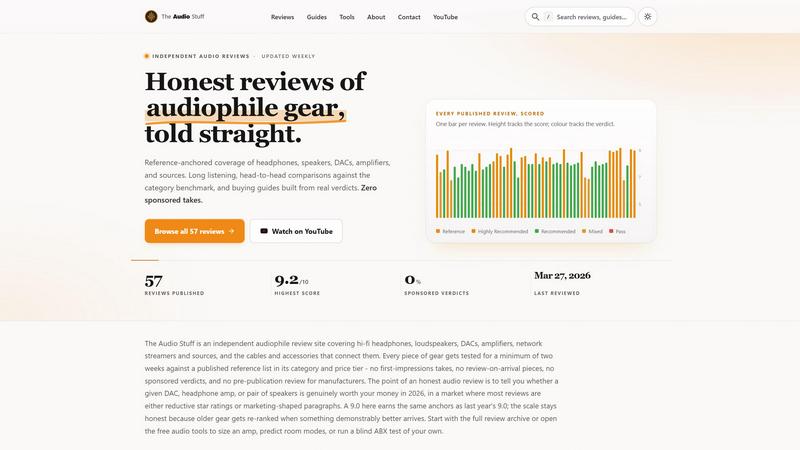
The Audio Stuff delivers brutally honest, benchmarked reviews of headphones, DACs, and amps to help you build a better hi-fi system without the fluff.

AI Rapper
AI Rapper transforms your ideas into catchy hooks, lyrics, and freestyle beats, empowering creators to elevate their rap game effortlessly.

OGTV
OGTV is a fast, modern Omegle alternative for genuine 1v1 video chats that turns random conversations into real friendships.

Yevideo - AI Video & Image Creation Platform
Yevideo is your all-in-one AI studio for generating stunning videos and images from text, images, and reference footage with advanced control.

Suno V6 AI Music Generator
Suno V6 AI Music Generator lets you easily create original songs, vocals, and tracks online with fast, export-ready audio.

SoniqTools
SoniqTools offers powerful audio editing, converting, and analyzing tools directly in your browser, ensuring complete privacy and no uploads required.
ClubDJ Pro
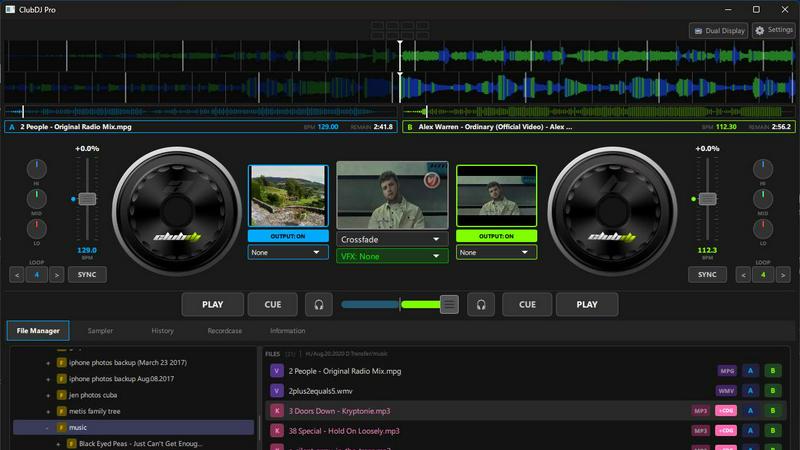
ClubDJ Pro empowers you to seamlessly mix audio and video like a pro with built-in dual-deck capabilities and stunning effects anywhere you go.

GenSong
GenSong instantly creates professional, royalty-free songs from text for any genre and platform.